
Natural Fibers vs Synthetic Fibers :A Comprehensive Beginner Friendly Full Guide
If you have bought garments or worked as a fabric purchaser, you must have seen these compositions on care labels:
- 100% Cotton
- 100% Polyester
- 95% Cotton, 5% Spandex
- 80% Nylon, 20% Spandex
All apparel on the market is made from textile fibers. Textile fibers fall into two broad categories: those sourced directly from nature, and those manufactured chemically via industrial processes.
Many people hold a fixed stereotype: natural fabrics = comfortable and safe; synthetic fabrics = stuffy, plastic feeling and toxic. However, when it comes to fabric selection, bulk purchasing and garment production, the reality is far more complicated.
This guide explains natural fibers, synthetic fibers and regenerated cellulosic fibers in plain language. It is easy for new textile practitioners to follow, and can also serve as a reference for clothing brands and junior fabric purchaser.
1. What Are Natural Fibers?
Natural fibers are extracted directly from natural raw materials, with mostly physical processing only no chemical reactions to create new high molecular polymers.
In the textile industry, natural fibers are split into two groups: plant fibers and animal fibers.
Plant Fibers
Common examples: Cotton, Linen, Hemp. They grow on plants, composed mainly of natural cellulose.
Animal Fibers
Common examples: Wool, Cashmere, Silk. These are natural protein fibers derived from animals.
A critical pitfall to note: natural fibers do not mean zero industrial processing. Cotton undergoes picking and spinning; wool goes through scouring and carding; silk requires reeling. A fiber qualifies as natural based on its raw material origin, not the absence of factory treatment.
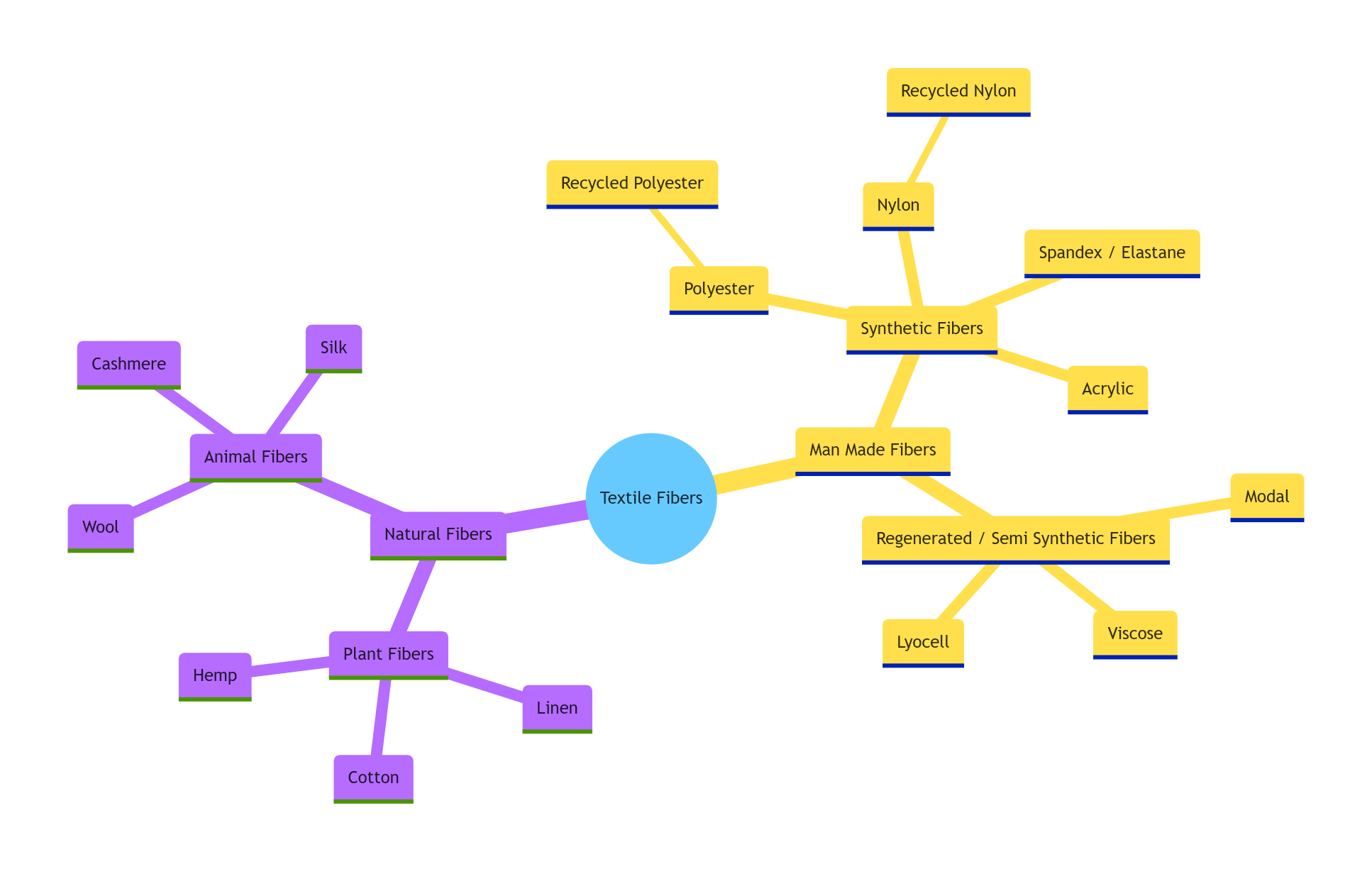
Mind map showing classification of textile fibers including natural fibers and man made fibers.Natural Fibers vs Synthetic Fibers
Another common mistake: many purchaser classify Viscose, Modal and Lyocell as natural fabrics. This needs clarification. Though made from wood cellulose, these fibers require complex chemical dissolution and regenerated spinning. They belong separately to regenerated cellulosic fibers or semi synthetic Fibers . They are neither conventional natural fibers nor true synthetic fibers.
2. What Are Synthetic Fibers?
Synthetic fibers are made from petrochemical feedstocks. New high molecular polymers are created through chemical synthesis, then melt spun into fine filaments.
The four most widely used types: Polyester (Polyethylene Terephthalate), Nylon (Polyamide,) Spandex, Acrylic.
Their performance varies greatly, but they share one core trait: they are not directly extracted from natural materials such as cotton or wool, but chemically synthesized from scratch.
Take Polyester as an example. Its raw material comes from petrochemical products. Manufacturers first produce polyester chips, melt them at high temperature, extrude the molten polymer through spinnerets into continuous filaments, then weave the yarn into fabric.
The core purpose of developing synthetic fibers is to overcome performance limitations of natural fibers. Garments may need high abrasion resistance, quick dry properties, or strong stretch and recovery without deformation performance that natural fibers alone can hardly achieve.
That said, synthetic fibers have drawbacks too; static electricity is a common issue. But the final wear experience depends not only on fiber type, but also on yarn count, weave structure and post finishing treatments.
Key Dividing Line
Viscose, Modal, Lyocell and Acetate do not count as synthetic fibers. Their raw material is plant cellulose instead of petrochemicals. They only undergo chemical re spinning, so they are categorized as regenerated fibers or semi synthetic fibers, distinct from polyester and nylon.
3. Common Natural Fibers List
| Fiber Name | Source | Core Properties | Typical Applications |
|---|---|---|---|
| Cotton | Cotton seed hair | Moisture absorbent, skin friendly | T shirts, shirts, underwear, bedding |
| Linen | Bast fiber of flax stalk | Cool touch, prominent texture, prone to wrinkling | Summer wear, dresses, home textiles |
| Hemp | Bast fiber of industrial hemp | High tensile strength, highly breathable | Casual tops, home textiles |
| Wool | Sheep fleece | Crimped structure, excellent warmth retention | Sweaters, overcoats, scarves |
| Cashmere | Downy undercoat of goats | Ultra light, soft, superior warmth | High end knitwear, scarves |
| Silk | Silkworm cocoons | Soft luster, silky smooth hand feel | Shirts, dresses, next to skin apparel |
Important note: these are general characteristics, not rigid rules. Cotton can be woven into thin plain jersey or thick terry cloth; wool can be processed into fine worsted yarn or bulky roving yarn.
A frequent confusion among new purchaser: Cotton is a fiber name, while Denim is a fabric name. Most denim is cotton based, but polyester and spandex are often added to improve elasticity. Fiber type and fabric name cannot be equated.
4. Common Synthetic Fibers List
| Fiber Name | Core Properties | Typical Fabric Applications |
|---|---|---|
| Polyester | Wrinkle resistant, quick drying, dimensionally stable | Sportswear, shirts, outerwear, home textiles |
| Nylon Polyamide | Exceptionally abrasion resistant, high tensile strength | Swimwear, activewear, hosiery |
| Spandex Elastane | High stretch & instant recovery | Elastic leggings, swimwear, fitted base layers |
| Acrylic | Wool like warmth, low cost | Knit sweaters, fleece blankets |
| Polypropylene | Very lightweight, nearly non absorbent | Functional outdoor fabrics, nonwovens |
Many people have a misconception: synthetic fibers equal stiff plastic cloth. This is not true. Polyester can be extruded into ultra fine filaments to create lightweight and soft fabric; Nylon can also be made with matte and delicate texture.
So when purchaser simply state “I want polyester fabric”, this requirement is too vague. It is also necessary to clarify end use, fabric weight, weave pattern, hand feel and functional requirements.
Supplement: Recycled polyester is still polyester in essence and belongs to synthetic fibers. It only replaces raw materials with recycled PET bottles; it does not turn into natural fibers. It is similar to remelting old steel to forge new iron, the material properties remain unchanged, only the source of raw materials is different. The same rule applies to virgin polyester and recycled polyester. Both are called Polyester, differing only in production routes and environmental performance. The same logic applies to recycled nylon.
5. Advantages and Disadvantages of Natural Fibers
✅ Advantages First, natural fibers come with unique surface texture and luster, which are hard to replicate for many synthetic fabrics. For brands focusing on natural style products, this serves as a core selling point.
Second, natural fibers generally deliver good skin friendliness, strong moisture and sweat absorption, and comfortable hand feel.
❌ Disadvantages
First, unstable performance, easily affected by service environment. Cotton fabric tends to shrink and wrinkle; wool requires high maintenance. It is not that they lack durability, these are inherent properties. Manufacturers need to adjust them via processes during production.
Second, batch variation of natural raw materials. Cotton and wool from different origins or harvest years differ in fiber fineness and length. Mills can control variation via cotton blending and spinning processes, but cannot eliminate it completely.
Third, natural fibers cannot meet certain special functional demands. For high stretch resilience, continuous quick dry performance and high abrasion resistance, it is difficult to achieve relying solely on cotton, linen or wool. Blending with synthetic fibers is usually required.
6. Advantages and Disadvantages of Synthetic Fibers
✅ Advantages First, performance can be custom tailored. Add spandex if elasticity is required; choose nylon for abrasion resistance; pick polyester for wrinkle resistance and easy care.
Second, yarn and fabric have huge adjustable space. By modifying yarn, weave and post finishing, you can achieve fabrics ranging from lightweight to heavyweight, matte to semi gloss and bright finish, smooth flat hand feel to brushed fleece and soft touch.
Third, stable dimension and low maintenance. Polyester in particular resists shrinkage and wrinkling, with low laundry requirements, suitable for many garment categories.
❌ Disadvantages
First, low moisture absorption, prone to static electricity in dry environments. Static electricity is not inevitable; it also relates to fabric structure and anti static finishing.
Second, microplastic fiber shedding during washing and friction. Tiny fibers of polyester and nylon may shed and enter water bodies after repeated washing and abrasion. This is the core environmental controversy of synthetic fabrics. The shedding volume is also affected by yarn type, weaving method and washing habits.
Finally, one key point: fabric comfort is not determined by whether it is synthetic. Well structured polyester sportswear can deliver great sweat wicking performance; tightly woven cotton without air channels can also feel stuffy.
7. Are Synthetic Fabrics Toxic?
When consumers see polyester or nylon, their first thought is: this is chemical plastic, will it harm the skin?
Here we need to separate three aspects clearly: chemical composition of fiber itself, auxiliaries used in dyeing & finishing, and safety standards of finished fabrics. Do not mix them up.
Synthetic fibers themselves are not toxic. Polyester, nylon and spandex are stable textile macromolecules. Just like food grade silicone and PE polyethylene used in food preservation, which are also artificially synthesized macromolecules. We cannot label them harmful just because they are man made.
The real risk source is not the fiber body, but the processing stage. Dyeing, printing, waterproofing, antibacterial and other functional finishing use various auxiliaries and dyes. Hazards mainly come from residual auxiliaries instead of polyester or nylon itself.
Itching for sensitive skin is not necessarily caused by toxic fibers. It may be skin irritation from dyes and finishing agents, fabric friction or sweat stimulation.
Conversely, natural fabrics are not automatically safe. Cotton and linen also use a large amount of chemicals during bleaching and dyeing. Neither natural fibers nor synthetic fibers can be simply tagged “safe” or “unsafe”.
For brands and purchaser, certifications are a more reliable way to judge safety. The widely accepted standard is OEKO TEX 100, which screens for harmful residues in fabrics.
8. Simple Fiber Identification via Burning Test
The burning test is a simple preliminary screening method widely used in factories and procurement. The principle is straightforward: different chemical compositions lead to different burning behavior, smell and ash residues.
⚠️ Important reminder: It is only for preliminary judgment. It is hard to detect the exact percentage of blended fibers via burning test, and cannot replace laboratory testing.
| Fiber | Reaction to Flame | Burning Behavior | Residue After Combustion |
|---|---|---|---|
| Cotton | Ignites easily | Steady burning, smell of burning paper | Grey powdery ash, crumbles easily when pinched |
| Linen | Ignites easily | Burning performance nearly identical to cotton | Light fragile ash |
| Wool | Shrinks and curls on heating | Slow combustion, strong odor of burning hair | Brittle black lumps that crush easily |
| Silk | Shrinks on heating | Slow burning, hair like odor | Small brittle black particles |
| Polyester | Melts and contracts first | Melts while burning, drips molten liquid | Hard black beads that cannot be crushed |
| Nylon | Melts and contracts | Melts before burning | Hard brownish black solid chunks |
| Spandex | Rapid thermal shrinkage | Melts and decomposes | Hardened sticky clumps |
When receiving unknown sample fabric and suspecting the composition differs from supplier’s claim, you can use this quick screening method.
⚠️ Safety Warning: Perform this test only in a well ventilated area with fire prevention measures. Do not carry it out casually at home. Molten dripping synthetic fibers can easily cause burns and fire risks.
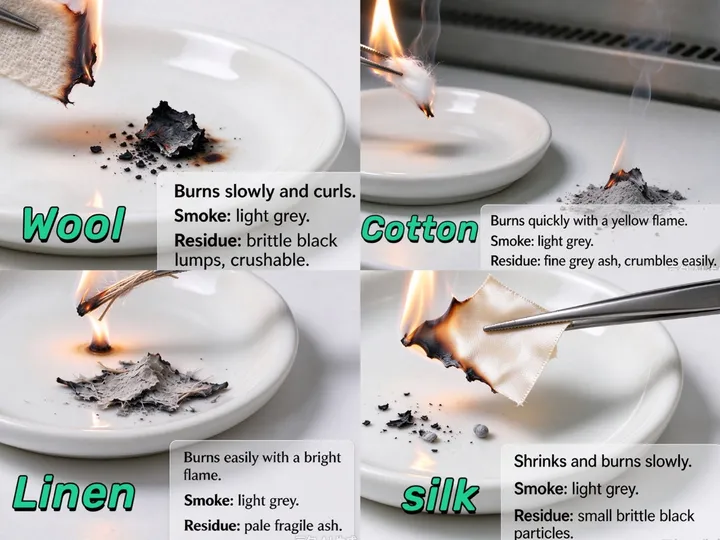
Natural Fibers Burn Test:wool,cotton,linen,silk
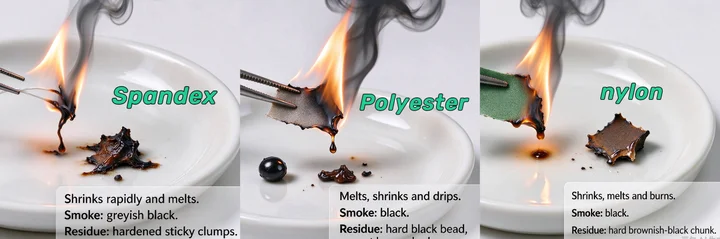
Burn Test of Synthetic Textile Fibers:spandex,polyester,nylon
9. Environmental Impact of Fibers: Which is More Eco friendly?
Many people draw a simple conclusion: natural = eco friendly, synthetic = polluting. This view is too one sided.
The full lifecycle of a garment includes raw material planting extraction, yarn spinning, fabric weaving, dyeing, transportation, daily laundering and disposal. Every stage creates environmental costs. Sustainability cannot be judged only by raw material source.
For natural fibers: Cotton planting occupies arable land, consumes massive irrigation water and relies on pesticides and fertilizers. Wool production relates to livestock emissions and land occupation. Renewable raw materials do not equal low resource consumption.
Biodegradability: Pure natural fibers can biodegrade under suitable temperature, humidity and microbial conditions.
For synthetic fibers: Virgin polyester and nylon rely on petrochemical resources. Polymerization and spinning consume energy and produce carbon emissions. Besides, as mentioned before, microfiber shedding during washing creates water pollution problems.
Recycled polyester reduces consumption of new petrochemical raw materials. However, sorting, cleaning and re spinning also consume energy, it is not zero pollution.
Biodegradability: Conventional synthetic fibers degrade extremely slowly in natural environments.
Nevertheless, the emergence of chemical synthetic fibers solves the conflict between cotton planting and food cultivation caused by population growth. It allows humans to reserve farmland for food production while meeting the clothing demands of billions without expanding cotton farmland.
10. What Are Blended Fabrics?
Most garments on the market are not made of single fiber. Blending mixes two or more fiber types to compensate respective weaknesses and achieve effects impossible for single fiber.
But blending does not simply stack all advantages of each fiber. Final hand feel and performance depend on ratio, yarn type, weave and post finishing.
- Cotton + Polyester Balances natural raw material properties with stable and easy care features. Widely used in T shirts, shirts, workwear and home textiles. Common ratios: 60% Cotton 40% Polyester, 50% Cotton 50% Polyester.
- Polyester + Spandex Polyester forms the base fabric, spandex provides stretch and recovery. Popular for casual sport T shirts and stretch training leggings.
- Cotton + Spandex Retain natural fiber features while adding elasticity. Used for stretch denim and base layers. Classic ratio: 95% Cotton, 5% Spandex.
- Nylon + Spandex Nylon delivers high abrasion resistance while spandex provides high elasticity. This is mainstream fabric for yoga leggings, swimwear and sports bras typical ratio: 75% Nylon, 25% Spandex.
- Cotton + Nylon Preserve natural texture while improving tensile strength and wear resistance. Widely used in casual wear and workwear.
- Wool + Polyester Retain wool’s warmth and texture while reducing shrinkage and improving durability. Common for overcoat fabrics and uniforms.
- Cotton + Linen Combine the benefits of both natural fibers, suitable for summer shirts and dresses.
- Viscose + Polyester Viscose delivers excellent drape; polyester stabilizes dimensional stability to prevent sagging. Very popular for women’s dresses and trousers. This also proves regenerated fibers are frequently used for blending.
