
What the Difference Between Rayon and Viscose? Modal vs Viscose vs Lyocell vs Cupro
1. Textile Fiber Classification
If you want to truly understand the difference between Rayon and Viscose, first we need to briefly learn the basic classification of garment fibers.
All fiber materials used to make clothing fabrics on the market fall into only two major categories: natural fibers and man-made fibers.
Natural fibers are materials directly produced by nature. Examples include cotton and linen from plants, wool and silk from animals. They only require simple processing before spinning and weaving.(natural fiber vs synthetic fiber)
Man-made fibers are fibers manufactured in factories through chemical processes. Among all man-made fibers, there is a big category made from natural wood pulp, but re-formed after partial chemical treatment. These are regenerated cellulose fibers, the core topic of this article. Both Rayon and Viscose belong to this category.
2. The Difference Between Rayon and Viscose
Are Rayon and Viscose the Same Thing?
Many people treat Rayon and Viscose as the same thing when reading care labels or communicating with suppliers. Strictly speaking, they are not equivalent.
Rayon is the term used in the US textile industry as a general name for all regenerated cellulose fibers. It is the American name for regenerated fibers. It is the name of a big category, not one single fiber type. Viscose is just the most basic and mass-produced branch inside the Rayon family.
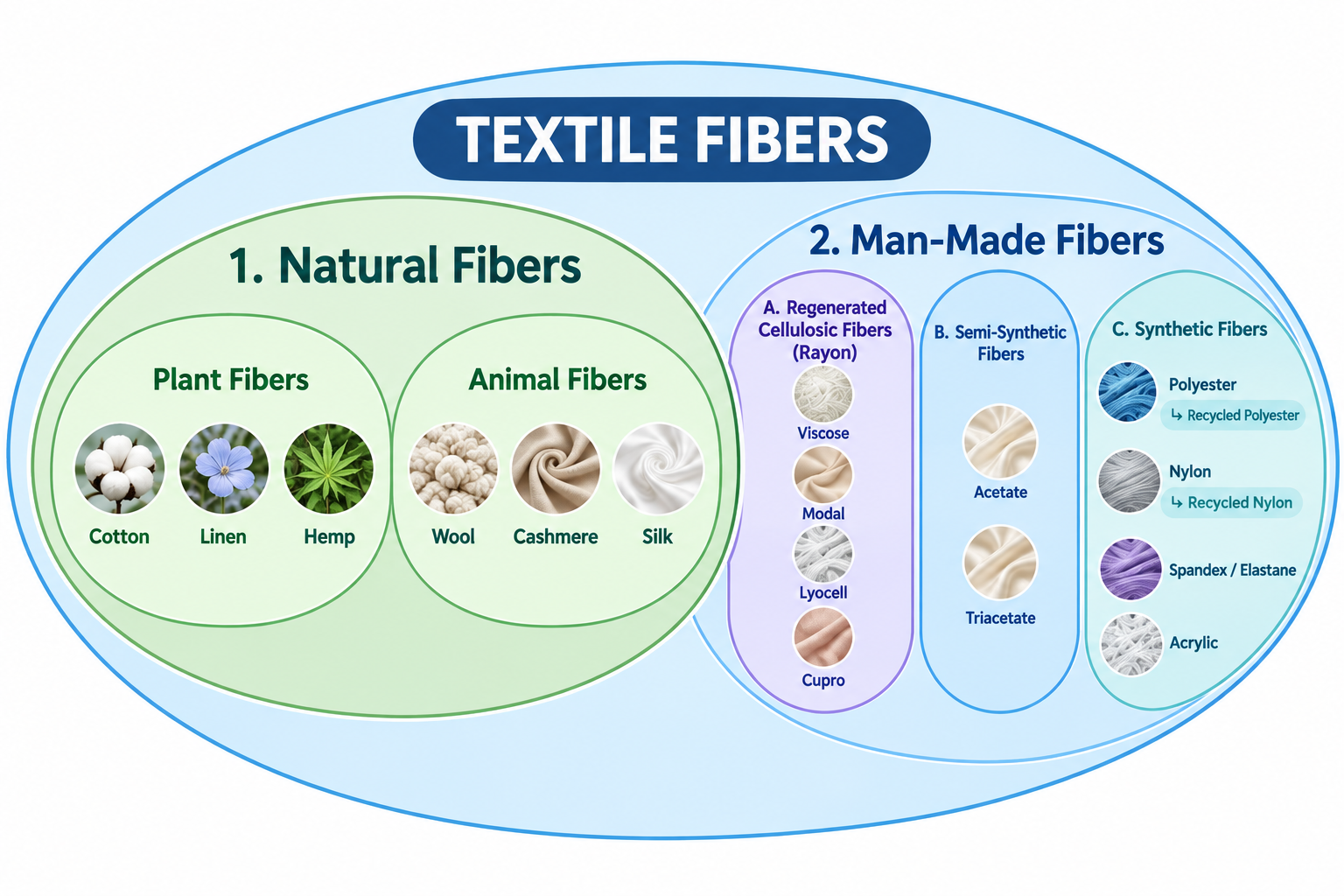
the classification of textile fiber
It is similar to when people talk about cars. The first thing that pops into your mind is a sedan. But cars include sedans, sports cars, trucks and more. Sedans are just the most common type, so people automatically associate cars with sedans.
Since Viscose has huge output and wide application, people in the industry often mix these two names in daily conversations. But in terms of classification, Rayon covers Viscose, Modal, Lyocell and Cupro, so its scope is much broader. Meanwhile, marking habits vary by region. The US market commonly uses Rayon as the general name, while the EU market prefers to mark the specific sub-fiber name directly.
What Is Viscose Fabric?
Viscose is the most basic and mass-produced fiber type within the Rayon family.
Fabrics woven from it have soft hand feel, good moisture absorption and air permeability, natural drape and friendly price. It is a very common regenerated fabric on the market. But its fiber structure is relatively loose. Its strength drops obviously after getting wet. Clothes made from it tend to shrink and wrinkle, and have average washing stability.
Modal vs Viscose vs Lyocell vs Cupro
All three fibers are made from high-purity wood pulp and belong to the Rayon family. The differences in their final performance come from different process settings during spinning. Let me explain the process differences in plain language.
Viscose
Production process: Wood pulp is soaked and treated with sodium hydroxide first, then reacts with carbon disulfide for xanthation to make spinning dope → the dope is extruded from the spinneret and solidifies into fiber in an acid bath → followed by desulfurization, washing, oiling and drying to get viscose fiber.
Compared with Modal, it does not carry out high-magnification gel stretching during solidification and forming, so the cellulose molecules inside the fiber are loosely arranged. Advantages: Fabric woven from it is soft with good drape, and raw material & process cost is the lowest. Disadvantages: Low wet strength. Fabric is prone to shrinkage and wrinkling after weaving, and has poor stability after repeated washing.
Modal
Production process: The solvent and basic reactions in the early stage are the same as Viscose: wood pulp treated with sodium hydroxide, plus carbon disulfide for xanthation to prepare spinning dope, extruded through spinneret holes into coagulation bath. Core difference: When the fiber is still in gel status, high-magnification stretching will be applied to straighten and neatly arrange cellulose molecular chains.
Then desulfurization, washing, oiling and drying are carried out to get Modal fiber. This stretching step is the key to its performance improvement. Advantages: Higher wet strength compared with ordinary Viscose; lower fabric shrinkage rate after weaving, better wash resistance, delicate and smooth hand feel. Disadvantages: Higher process cost; fabric has a slight tendency to fuzz after long-term friction.
Lyocell
Production process: Its technical route is completely different from the above two. There is no xanthation reaction in the whole process. It uses NMMO (N‑methylmorpholine‑N‑oxide) as solvent to directly dissolve cellulose inside wood pulp and prepare spinning dope. The dope is ejected from spinneret orifices, passes through a short air gap first, then enters water bath for solidification and forming. After washing, oiling and drying, we get Lyocell fiber.
The NMMO solvent separated in washing can be recovered, purified and recycled for production, with a very high recovery rate. Advantages: Good fiber strength both under dry and wet conditions; woven fabric has stable dimension and is not easy to wrinkle, and the production process is more eco-friendly. Disadvantages: High threshold for the whole set of equipment and technology, so fiber cost is the highest; fabric may have fibrillation under certain weaving methods.
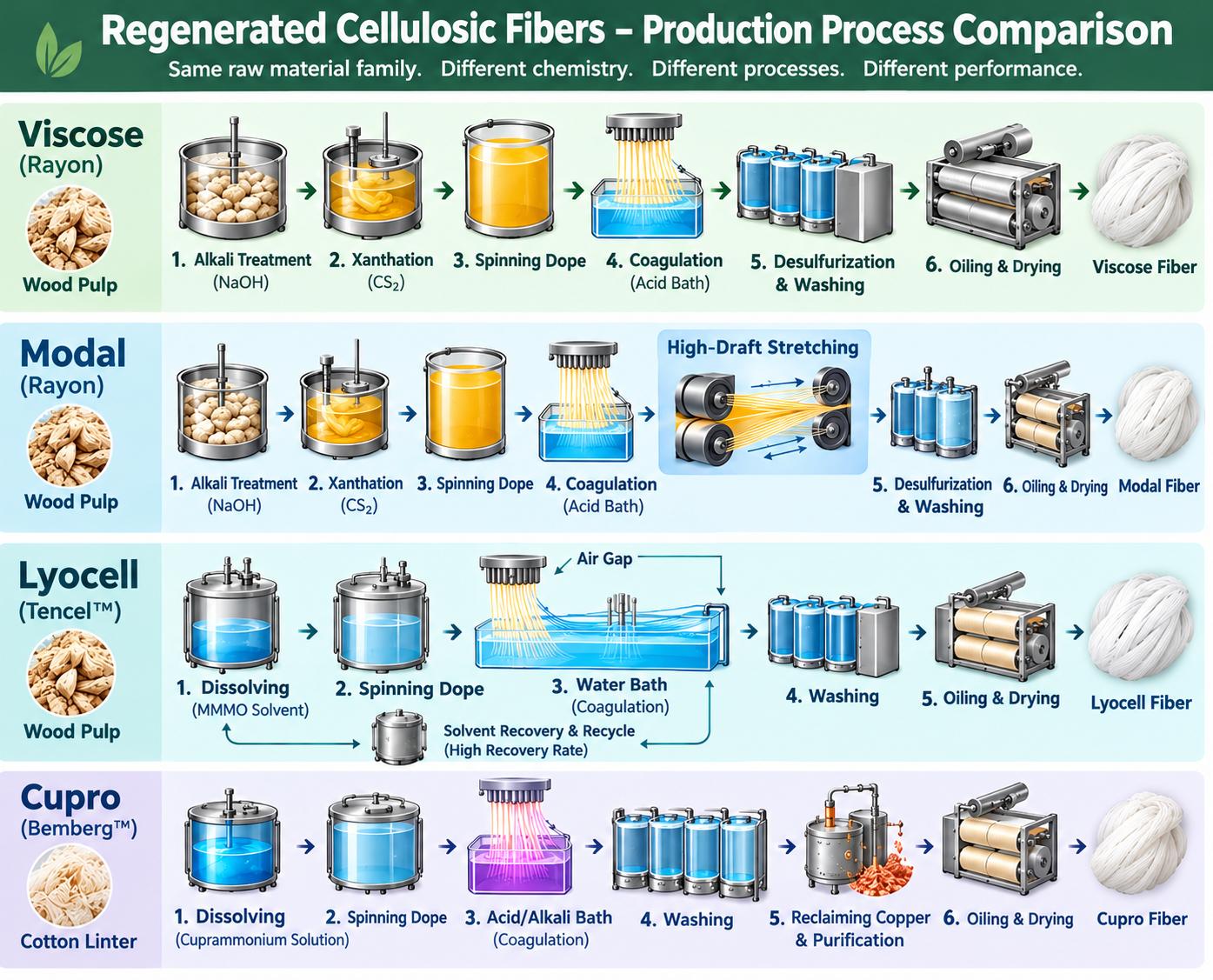
production process comparison of Modal vs Viscose vs Lyocell vs Cupro
What Is Cupro Fabric?
Cupro, namely cuprammonium fiber, also belongs to the Rayon family, and it is a niche high-end variety. Its raw material is not wood pulp, but cotton linters. Cuprammonium solution, which is ammonia solution of copper hydroxide, is used to dissolve cellulose. Cellulose inside cotton linters dissolves in cuprammonium solution to make spinning dope. After the dope is extruded, cellulose precipitates and forms fiber in coagulation bath of dilute acid and dilute alkali. Copper components are separated and recovered in follow-up procedures, so the final cupro fiber has almost no copper residue.
Cupro fiber itself is fine and smooth with soft luster, and fabric woven from it has excellent drape. Due to strict process control requirement and limited output, its cost is relatively high. It is mostly used for high-grade garment lining and premium next-to-skin fabric.

RS002 Innovative Textiles|Bamboo Power Mesh Fabric|Underwear Fabric
What Is Bamboo Viscose Fabric?
Bamboo viscose also falls under Viscose category. Its chemical reaction and full set of production process are exactly the same as ordinary wood-pulp viscose. The only difference lies in raw material: instead of wood pulp, it uses bamboo pulp extracted from bamboo.
Our Wingtex RS002 bamboo fiber mesh fabric is blended with bamboo viscose, recycled nylon and spandex. It is skin-friendly, soft and breathable, suitable for underwear.
3. Other Man‑Made Fibers
Besides regenerated cellulose fibers we mainly talked about, man-made fibers also include two major categories: semi-synthetic fibers and synthetic fibers. Here is a brief introduction.
Semi‑Synthetic Fibers
Their raw material is also cellulose (wood pulp), but there is one key difference from Rayon series. For Rayon, cellulose is only dissolved and separated, then restored back to cellulose. The chemical main body of cellulose remains unchanged in the whole process.
But for semi-synthetic fibers such as acetate and triacetate, esterification reaction happens between cellulose and acetic acid. Acetyl groups attach to cellulose molecules. The chemical structure has been modified, and it is no longer the original cellulose. This is why it is not classified as Rayon in industry standards. Finished fabric has transparent and smooth luster, not easy to wrinkle. It is commonly used for evening gowns and lining of high-end garments.
Synthetic Fibers
They are synthesized from petrochemical raw materials and have nothing to do with plant cellulose. They are often blended with Rayon. Main types include polyester, recycled polyester, polyamide, recycled polyamide, spandex and acrylic
Related Article
Natural Fibers vs Synthetic Fibers:A Comprehensive Beginner Friendly Full Guide
What Is The Difference Between Of Recycled Fabric (Repreve) And Rpet Fabric?
