Nylon vs Polyester vs Spandex, What Is Their Difference? A Beginner’s foolproof Guide for Fabric Sourcing
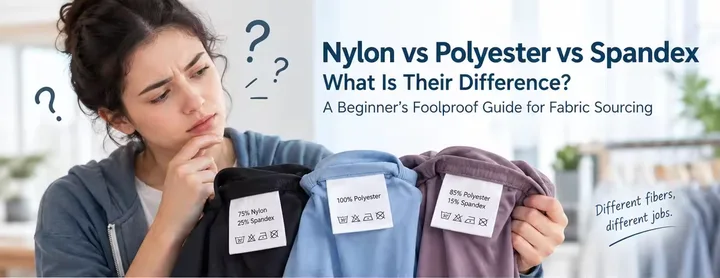
Suppose you are new to knit garment fabric sourcing and want to know what material leggings are made of. You flip to the care label inside the garment and see it marked:
75% Nylon, 25% Spandex
You wonder: What is Nylon? What is Spandex?
A few days later, you see an athletic T-shirt, whose care label reads:
100% Polyester
There is another pair of leggings with composition:
85% Polyester, 15% Spandex
Why do some garments use nylon while others use polyester? Why is spandex always blended with other fibers? If all three materials can be used for clothing, what exactly is the difference between them?
In fact, these three names stand for three different synthetic fibers. They each have their own characteristics and undertake different functions in fabrics. Once you understand this, you can read the logic of material selection behind many garment care labels.
I. Nylon vs Polyester vs Spandex, What Is Their Biggest Difference?
First remember a simple concept: Nylon and polyester can act as the main fibers of fabric, while the most prominent value of spandex is to provide high elasticity.
Of course, this does not mean nylon and polyester fabric have no elasticity, nor does it mean spandex can only be matched with these two fibers. They just have different material properties, so they often take on different roles in garment development.
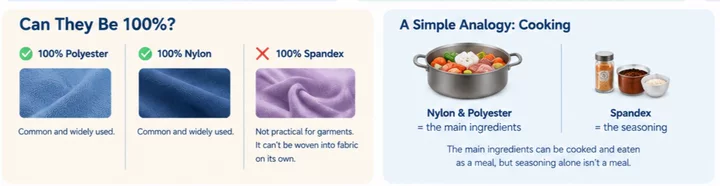
This brings up a question frequently asked by new beginners: Can there be 100% polyester fabric, 100% nylon fabric, or 100% spandex fabric?
The answer: 100% polyester and 100% nylon are both very common garment fabrics. For example, 100% polyester is often seen in polyester shell fabric for windbreakers we commonly see, quick dry T shirt fabric, polyester bird’s eye mesh fabric used as lining for sportswear, and so on. Fabrics made of 100% nylon are known in the textile industry as nylon taffeta, taslan, commonly used for sun protective clothing, outdoor jackets, nylon windbreakers and so on.
However, there is almost no such thing as 100% spandex fabric on the market. If you see one marked this way, it is mislabeling by merchants. Spandex can be spun into filaments alone, but it cannot be woven into garment fabric by itself. Pure spandex lacks supporting structure; it is prone to permanent elongation and deformation under force and cannot be directly cut and sewn. Therefore, spandex yarn can only be used as an elastic component blended with other fibers.
100% nylon and 100% polyester can both be directly woven into garment fabrics, obtaining slight basic elasticity by knitting structure. This belongs to structural elasticity, not the strong recovery elasticity like adding spandex.
How to understand this more simply? Compare making a piece of fabric to cooking. Nylon and polyester can both serve as main ingredients, while spandex is the seasoning that gives flavor to the dish. The main ingredient can be cooked and eaten as staple food without seasoning, but seasoning almost cannot be eaten as staple food alone.
Back to the original question: What is the biggest difference between nylon, polyester and spandex?
-
Nylon: Why is it often used in underwear fabric and yoga fabric?
Nylon is a synthetic fiber with good strength and abrasion resistance.
In garment fabrics, it is frequently used for yoga fabric, athletic leggings, swimwear and underwear. When blended with spandex and adopting suitable knitting structure, it can produce fabrics with elasticity, body-hugging fit and wear resistance.
Moreover, nylon fabric does not have only one hand feel. Its hand feel and appearance can be diversified with different processes. Some nylon fabric have smooth surface and delicate touch; some have natural matte effect; others present soft, fine or other special surface textures through yarn selection and finishing processes.
Therefore, if you want to develop yoga wear, athletic leggings or tight-fitting activewear, choosing nylon as one of the fabric components is a good option to consider.
-
Polyester: Why is it widely used and almost everywhere?
Polyester is one of the most widely applied synthetic fibers in the textile industry.
Athletic T-shirts, training garments, outerwear and various knitted and woven clothing may adopt polyester fabrics. Polyester features good durability, dimensional stability and easy daily care. Besides, it can be developed into many different fabrics through different yarns and processing techniques.
For example, fabrics using polyester as main fiber can be thin and breathable for athletic T-shirts; some have smooth surface suitable for training garments; after waterproof finishing, they can be made into waterproof garments; others can form soft fleece hand feel through brushing and other finishing processes for autumn and winter clothing.
This reflects an important point: merely knowing the fiber percentage composition cannot fully judge the hand feel, thickness and end use of a fabric.
Even if two fabrics are both marked 100% Polyester, they may show completely different characteristics due to differences in yarn specification, fabric structure, gram weight and finishing processes.
So polyester’s advantage lies not only in its wide application range, but also its ability to adapt to various fabric design requirements.
-
Spandex: Why can a small amount of spandex change the wearing experience of a fabric?
Spandex, also known as Elastane, is a synthetic fiber famous for high elasticity and stretch recovery capacity.
Compared with nylon and polyester, the most prominent function of spandex in conventional garment fabrics is to endow fabrics with better stretch ability and stretch recovery performance.
Imagine the wearing difference between a pair of pants with no elasticity at all and a pair of leggings that stretches freely with leg movements.
This is where spandex works. When spandex is added to nylon or polyester fabrics, the fabric can obtain required elasticity to better adapt to body bending, stretching and sports movements.
Therefore, spandex often appears in yoga wear, leggings, underwear, swimwear and other garments requiring elasticity.
However, the proportion of spandex cannot directly determine the overall elastic performance of a fabric.
Spandex yarn types, knitting structure and processing techniques also affect the final effect.
That is why two fabrics with the same spandex content may still have different actual stretch performance.
II. Why some fabrics use nylon + spandex, while others use polyester + spandex?
Now let’s go back to the care labels we saw at the beginning.
One pair of leggings uses 75% nylon and 25% spandex, while another pair of athletic leggings uses 85% polyester and 15% spandex.
Their difference is not only the fiber names, but also the ideas behind fabric development.
Nylon + spandex is commonly used for high end yoga wear, athletic leggings and tight fitting activewear. Nylon provides the main fiber base of the fabric, and spandex gives fabric elasticity. Different yarn design, knitting structure and finishing processes can further adjust fabric hand feel, appearance and wearing performance.
Polyester + spandex is widely used for athletic T shirts, training wear, elastic leggings and other functional garments. Polyester acts as the main fiber, spandex provides elasticity, and the combination of both can meet different garment development requirements.
Then, is nylon + spandex better than polyester + spandex?
No. There is no absolute good or bad, only matching for different demands.
If you want to develop yoga pants emphasizing body hugging effect, wear resistance and delicate touch, nylon + spandex fabric may be a good option.
If you want athletic T-shirts, training garments or leggings with good moisture wicking performance, then polyester + spandex fabric is also worth considering.
What really decides whether a fabric fits the target product is the coordination between fiber composition, yarn, fabric structure, gram weight and finishing processes, instead of simply judging which fibers combination is more premium.
III. What composition should be selected when sourcing fabrics?
If you are an apparel brand, ready made garment manufacturer or fabric purchaser, rather than directly asking which composition ratio is the best, you should first confirm what product you are going to develop.
For example:
Yoga wear and leggings fabric:
You can mainly consider nylon + spandex fabrics, and also select polyester + spandex fabrics according to product design.
Athletic T-shirts and training garments fabric:
You can consider polyester fabrics; if extra elasticity is required for the product, polyester + spandex combinations are also available.
Swimwear fabric:
Both nylon + spandex and polyester + spandex can be used for different types of swimwear fabrics. Generally polyester is more widely used for its good chlorine resistance. Specific selection needs to combine the design requirements of target products.
After understanding care labels, you will find that fiber names on clothing are not combined randomly. They reflect different ideas in material selection for products.
But for real fabric development, what determines the final product performance is never just a few percentages on the composition table.
Fibers decide the material foundation; yarn and fabric structure shape fabric characteristics; different processing techniques further affect final appearance, hand feel and wearing experience.
Understanding the relationship between these three allows you to judge more clearly what products different fabrics are suitable for, and put forward more accurate requirements during sourcing.