
From the Micro Perspective of Textile Science: Why Do Clothes Pill?How to Solve Leggings Pilling Problem
Let’s simply answer this question first. You can understand fabric pilling of clothing as one thing: The fibers on the fabric surface originally stay neatly inside the yarn. After wearing, friction and washing, part of the fibers are pulled out and tangled together, and finally small fiber balls form on the fabric surface. This is pilling.
But if you really want to understand pilling, we have to start from the simplest things and explain clearly step by step in plain language.
I. First Step: Understand How Fabric Is Composed?
Fabric is not a whole connected block without internal structure; it is formed by interweaving yarns. Yarn is not a single thin filament, but formed by gathering many fine fibers together.
Fabric: Many yarns are combined together through knitting or weaving.
Yarn: A large number of fibers are gathered and twisted into a complete thread through processes such as twisting.
Fiber: A very tiny material unit, the basic micro unit that constitutes fabric. Nylon, polyester and cotton fibers all belong to this category.
You can imagine yarn as a twisted hemp rope. Many fine threads are twisted inside the hemp rope, and these fine threads are fibers. Under normal circumstances, fibers hold each other and stay neatly inside the yarn, and the fabric surface also looks relatively flat.But the problem is these fibers cannot stay inside obediently forever.
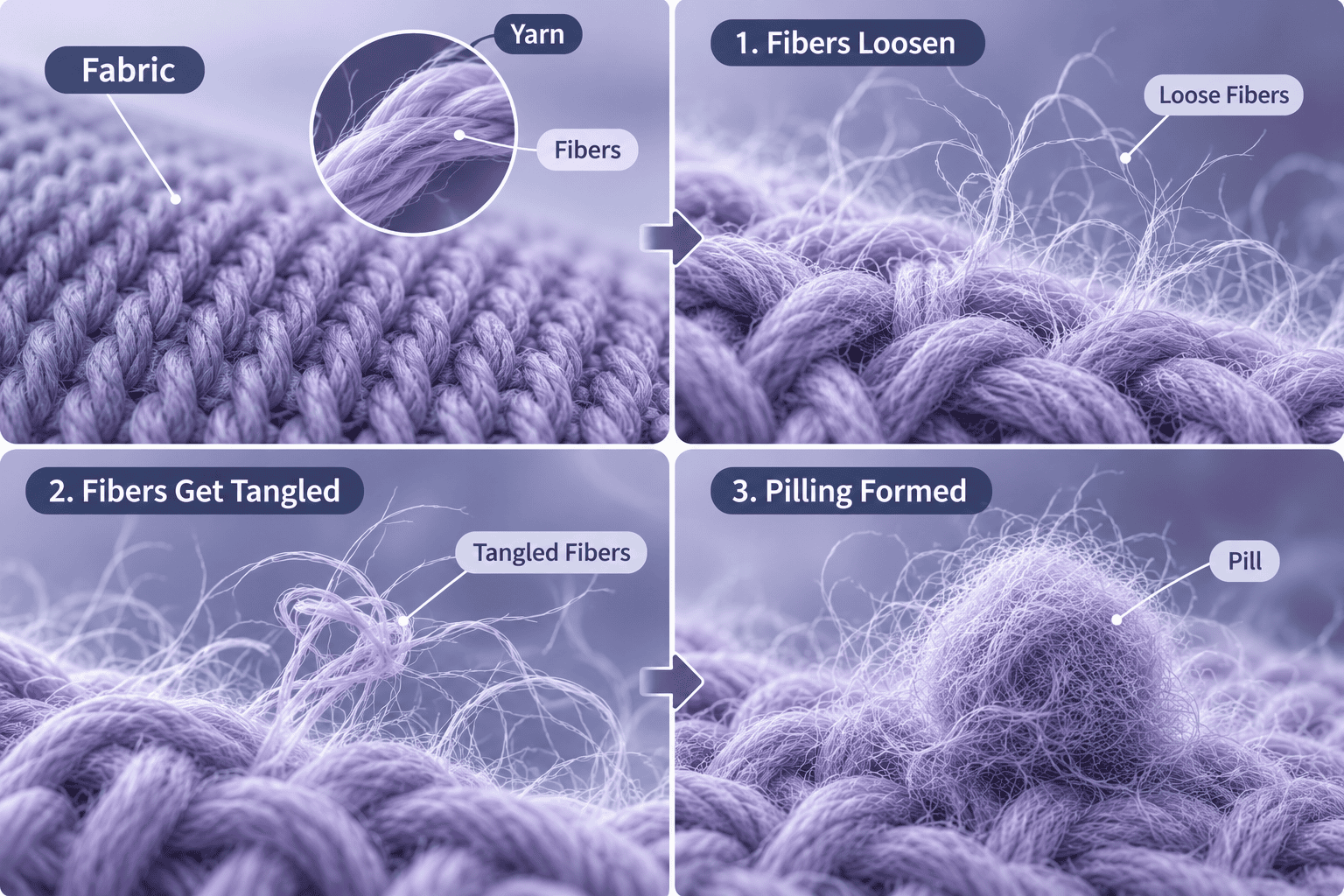
The main reason is: friction makes fibers escape from yarns, then these escaped fibers tangle with each other and finally form fiber balls.
We split this process into 3 steps.
Why Do Clothes Pill?
Step 1: Fibers get loose under friction.When clothes are worn, friction occurs continuously. The inner thighs of yoga pants rub against each other. Clothing sleeves rub against the body. Clothes rub against each other during washing.
These frictions keep pulling the fibers on the fabric surface. Some fibers that originally hold tightly inside the yarn will gradually get loose. Especially some fibers on the yarn surface may be pulled out and expose a short section.
At this time, small fuzz starts to appear on the fabric surface.(Note: Obvious fiber balls may not be seen at this moment; fibers just start to stick out from the yarn.)
Step 2: Fibers are pulled longer and exposed on fabric surface The clothes keep being worn and rubbed. Those loosened fibers will be pulled repeatedly. At first only a little part is generated, then the exposed part becomes longer and longer. You can imagine several fine threads pulled out from a hemp rope.
At this time, the fabric surface becomes rougher and rougher.
Here is a very key point: Why can fibers be pulled out? The fibres are not fused tightly together and inseparable, but maintain stability mainly through cohesive forces and friction between fibres, as well as the twist and structure of the yarn. When external friction keeps acting, if the pulling force exceeds the binding capacity between fibers, fibers will easily slide out.
Step 3: The escaped fibers tangle with each other This is the most critical step of pilling. When the clothes keep rubbing, those fibers stuck out on the fabric surface will receive pulling forces from different directions continuously. Some fibers bend, some tangle together, some hook adjacent fibers.
As time passes, these fibers tangle together and form a small fiber cluster. Just like messy hair tangled into a small lump.
At this time, small fiber balls start to appear on the fabric surface. The fiber cluster tangles tighter and forms obvious pilling. As friction continues: more fibers are pulled out. More fibres become entangled with the original fibre cluster. The small fibre cluster gradually grows larger, and pilling becomes increasingly noticeable. Finally, what we see with the naked eye are small pills on the garment surface.
This is the complete pilling process.
II.How to Solve the Leggings Pilling Problem
In daily life, brushed fabric is one of the fabrics most prone to pill, such as brushed thermal underwear and brushed yoga pants. Brushed fabric needs special attention to this problem.
As mentioned above, the first step of pilling is part of fibers escaping from the fabric surface. The brushing process itself uses machine friction to artificially make part of fibers escape, generating a layer of fine nap on fabric surface to get soft touch. Ordinary fabrics need a period of friction to cause fibers escape, while brushed fabric artificially completes the first step of pilling.
But this does not mean all brushed fabrics are easy to pill. The key is how to control fibres on the fabric surface to make them hard to fall off and resist tangling.Take brushed yoga pants as an example:
- Polyester VS Spandex, which has better anti-pilling performanceCurrently, there are two mainstream yoga pant fabrics on the market: nylon-spandex blend and polyester-spandex blend. If good anti-pilling performance is required, nylon-spandex fabric is the better choice. Under the same process, nylon has good strength, wear resistance and soft hand feel compared with polyester fabric, widely used in high-quality yoga pants and sportswear. High-quality nylon filament yarn has relatively smooth surface, suitable for developing brushed fabrics with delicate touch and flat surface. Moreover, after polyester fabric forms fiber balls, these fiber balls are harder to fall off from fabric surface than nylon.
It needs to be clear that spandex is not a material specially used to prevent pilling. Spandex is mainly responsible for providing elasticity and recovery ability, allowing yoga pants to return to original shape after stretching.
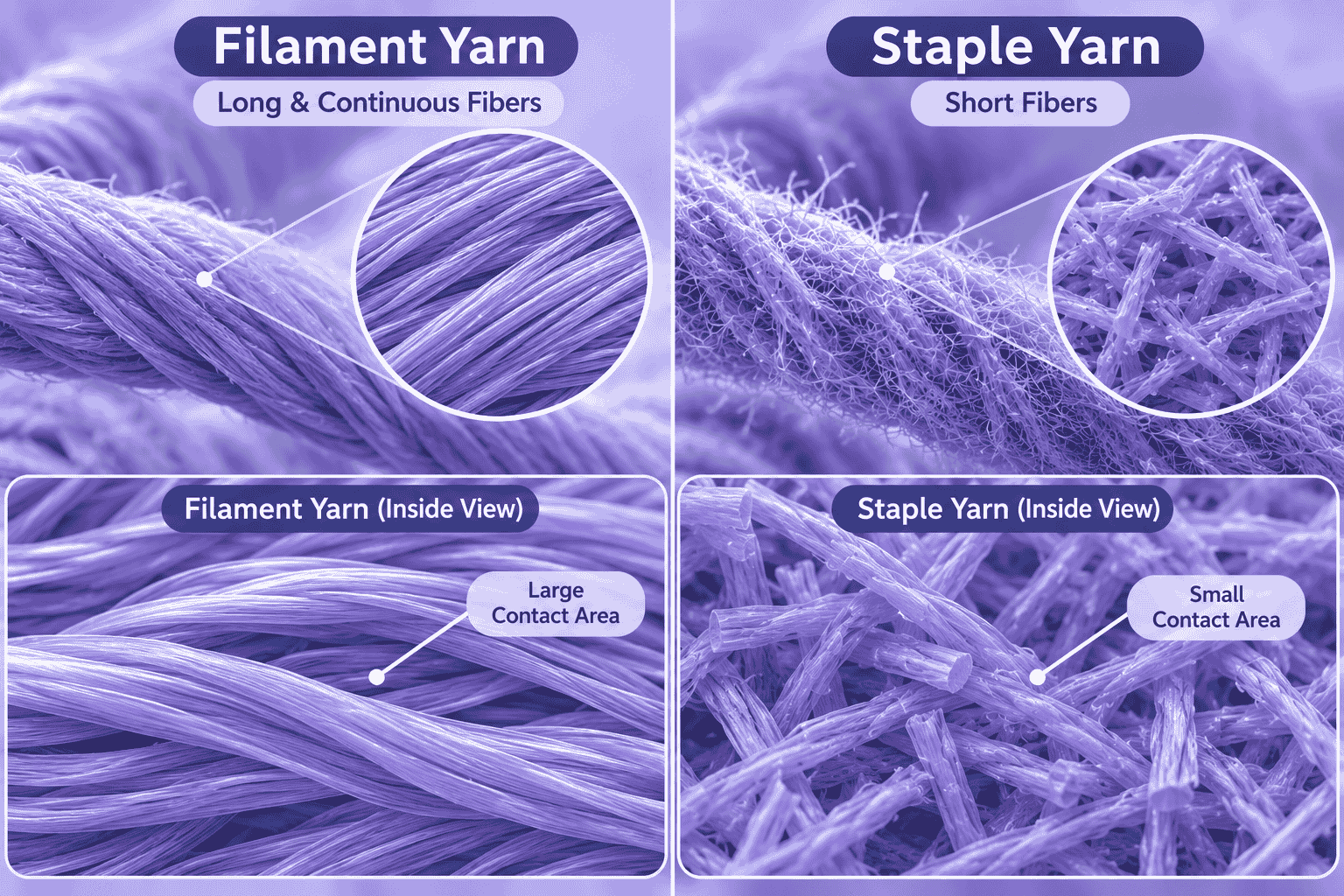
- Filament Yarn VS Staple Yarn, which has better anti-pilling performance?Why?Filament yarn:
composed of one or more continuous fine filaments.
Staple yarn: composed of many shorter fibers combined together.
For filament yarn, since continuous fibers are long, the contact area between fibers inside the yarn is larger than that of short fibers, so the cohesion force is stronger. Also because fibers are long, it does not have so many exposed fiber ends like staple yarn, so it is easier to get relatively smooth yarn surface. Therefore for yoga pants, high-quality nylon filament yarn can be prioritized.
Filament Yarn VS Staple Yarn, which has better anti-pilling performance?Why?
- Select stable knitting structureCommon knitting structures for yoga pants include: Interlock (double-sided weft knit), Jersey (single-sided weft knit), Tricot warp knit.
Among them, Interlock double knitting structure is worthy of priority consideration, because it adopts double loop structure and can form relatively stable and compact fabric. Stable knitting structure can help yarns stay at relatively fixed positions and reduce unnecessary movement of yarns during wearing. Compared with the other two weaving methods, it is more suitable for making brushed yoga pants.(Learn the relevant textile knownledge:The Difference Between Woven VS Knit Fabric|Warp Knit&Weft Knit&Tricot?)
- Control brushing processThe brushing process is an important stage affecting the final quality of brushed yoga pants.Brushing uses special machines to generate friction with the fabric surface, bringing some fine fibres to the fabric surface to form a soft and delicate nap effect.
But excessive brushing force may bring some problems: too many fibers pulled to fabric surface. Some fibers or filaments get damaged. Fabric surface becomes loose and uneven. The risk of pilling increases in subsequent wearing.If the brushing force is too light, the fabric may not achieve the expected softness and nap hand feel.
Therefore, a proper balance point needs to be found in the production process.
III.How to prevent Leggings Pilling Problem & solutions if pilling occurs
Besides yarn and knitting processes, proper washing habits can greatly delay fuzzing and pilling of the fabric.
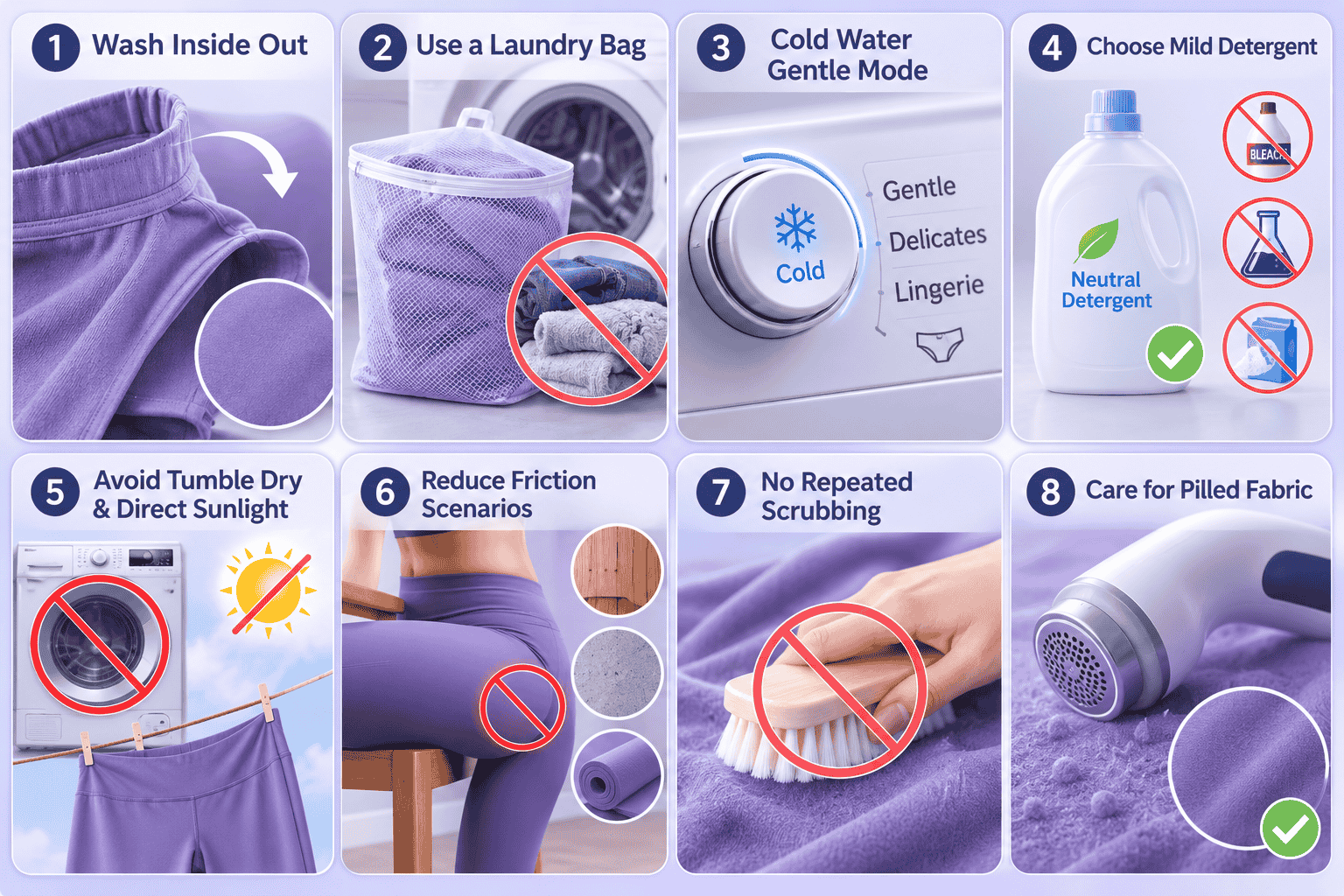
(1) Wash inside out :Turn yoga pants inside out before washing to reduce direct friction between the fabric face, the washer inner wall and other garments, protecting the fine nap on lightly brushed fabric surfaces.
(2) Use a laundry bag; avoid mixed washing with rough clothes :Wash in a laundry bag whenever possible. Do not wash together with abrasive fabrics such as denim, towels and hoodies. Rough fabrics are the main source of friction that causes pilling.
(3) Cold water gentle mode washing :Choose cold water and the gentle & lingerie cycle to reduce heavy friction from high-speed agitation. Excessively high water temperature damages spandex elasticity and lowers fibre fastness, making fuzzing more likely.
(4) Detergent selection :Use neutral laundry liquid. Avoid bleaching agents, chlorine-containing disinfectants and strongly alkaline washing powder. Chemical agents corrode fibres, making monofilaments brittle and broken and inducing fuzzing.
(5) Avoid tumble drying and direct sunlight :Do not tumble dry. High temperature ages spandex and damages nylon & polyester fibres. Hang dry in a cool, well-ventilated place. Prolonged direct sunlight also makes fibres brittle.
(6) Reduce friction scenarios :Avoid wearing yoga pants while sitting directly on rough wooden chairs, concrete floors or coarse yoga mats. Repeated friction from backpack sides against leggings will also accelerate pilling.
(7) Do not repeatedly scrub the brushed area by hand :Lightly brushed fabric has inherent fine nap on its surface. Heavy scrubbing pulls out fibres and triggers pilling.
(8) Care for pilled fabric :If tiny pills have formed on your yoga pants, use a fabric shaver or sweater comb to trim them gently. Never pull pills off by hand, as this will loosen more fibres and cause heavier pilling. Always work on clean, dry fabric and move the tool slowly across the surface.
How to prevent Leggings Pilling Problem & solutions if pilling occurs
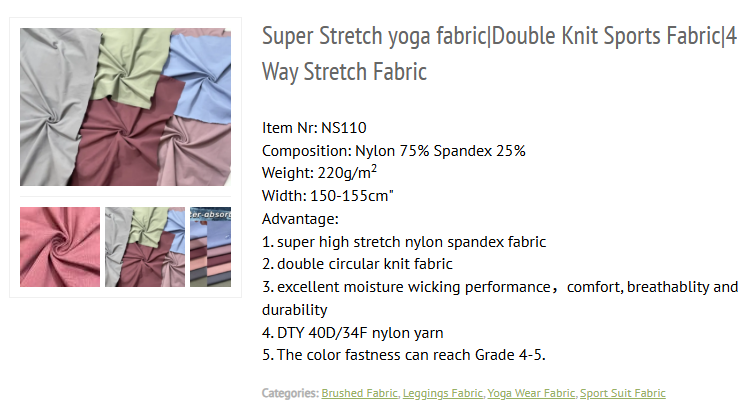
Wingtex ns110 75%nylon 25% spandex interlock knit light brushed fabric comparable to lulu fabric.
Our product adopts high-quality DTY 40D/34F nylon filament yarn, interlock knitting method, and passes professional light brushing treatment. This fabric has excellent anti-pilling performance, and can achieve the same hand feel and performance as lulu, but the price is much lower than lulu. Designers and fabric buyers are welcome to ask us for free samples.
Wingtex ns110 75%nylon 25% spandex interlock knit light brushed fabric comparable to lulu fabric.
