What is rPET Recycled Polyester Fiber? Foolproof Explanation
The plastic drink bottle you casually throw away and the polyester fabric clothes you wear seem totally unrelated. One is worn on the body, the other discarded after use.
But in fact, they are “relatives”, because both of them are composed of the same chemical material – polyethylene terephthalate, and PET is the abbreviation of it, so if we mention the same core chemical composition, we will directly use PET. Abbreviation to represent, which is more concise and convenient.
What is the relationship between PET and polyester fabric?
When solid PET at room temperature undergoes melting and spinning to be drawn into fine filaments, it becomes polyester fiber.
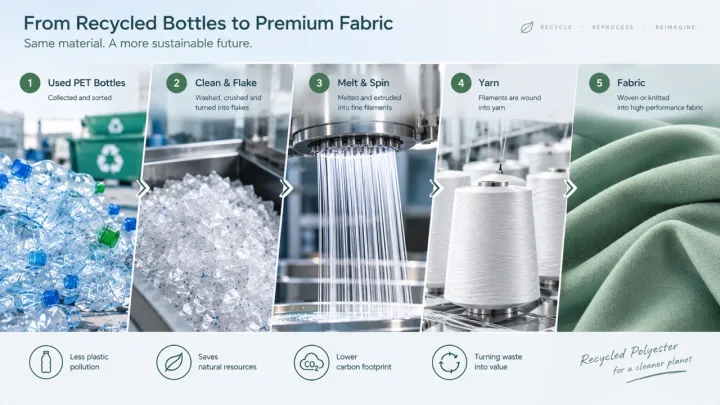
the process of wingtex recycled polyester fabric
In plain terms:
If solid PET (resin / plastic bottles)at room temperature is compared to solid sugar chunks,
then Polyester fiber is the drawn sugar strand.
The chemical composition remains exactly the same. We just heat and melt ”the solid sugar chunks”, pull them into fine long filaments, turn filaments into yarn, and then weave yarn into polyester fabric.
The raw material itself does not change; only its physical form is modified through processing.
Many sportswear, quick dry clothing and some yoga wear fabrics you commonly wear are mainly made of polyester fiber. Clear plastic drink bottles are also commonly manufactured from PET. Though their end uses differ, they share the same base chemical material.
Since their base material is identical, plastic bottles can be remade into clothing.
Waste PET bottles can be remade into PET chemical raw materials suitable for spinning after sorting, cleaning, crushing and reprocessing, and then made into polyester fibers through melting spinning and other processes, and finally processed into yarns and fabrics. This is the basic principle of recycling plastic bottles into textile materials.
This recycled polyester made from post-consumer PET material is generally called rPET (Recycled PET).
Conventional polyester is normally produced with petroleum as the raw material, while rPET reuses existing PET material to fully recycle and turn waste into valuable goods.That is the biggest difference from ordinary polyester lies in the source of raw materials.
In 1993, Patagonia and the fiber factory Wellman (brand fiber trademark Ecospun) launched the world’s first fleece jacket made of recycled PET plastic bottles,
In the early days, recycling technology for rPET was limited. When plastic bottles were melted, polymer chains broke. Impurities and color variation were hard to control, resulting in unstable fabric strength. It could mostly only be used for low-grade staple fiber.
Thanks to technological upgrades today, AI sorting, deep adhesive removal, SSP solid-state polycondensation and precise filtration repair polymer chains, improve viscosity and strength. The material can be used for close-fitting stretch fabrics such as yoga wear.
The newer chemical recycling technology is even more powerful. It breaks PET down back into monomers and re-polymerizes it. The finished product delivers performance close to virgin raw material. Even colored and mixed waste can be utilized to produce higher-quality recycled fabric.
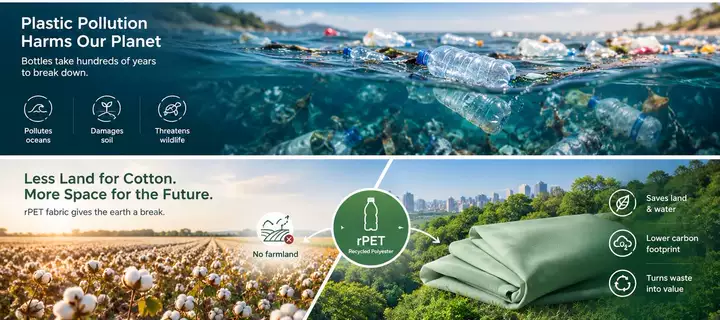
Global demand for clothing keeps rising alongside population growth. Relying solely on traditional cotton cultivation cannot meet the clothing supply for all people.
Farmland is limited. We need to grow food to feed humanity, yet large areas of land are also required for cotton farming for textiles. This naturally creates unavoidable conflict over resources. The emergence of rPET recycled fabric solves this challenge perfectly.
It does not need to occupy an inch of arable land, do not need to water and fertilize, and does not rely on agricultural output at all. It continuously produces high quality fabrics from energy sources. It not only grabs land and water from grain, but also can easily meet the growing global demand for clothing, which fundamentally alleviates the pressure on clothing resources and food and arable land caused by population growth.
At the same time, massive volumes of plastic bottles and PET waste in daily life hardly biodegrade. They are buried and entered the sea all year round, continuously destroying the soil and marine ecology, which is a globally recognized stubborn pollution problem.
rPET recycling technology is equivalent to finding an excellent home for these waste plastics. Waste plastics that would otherwise pollute the environment are reprocessed into premium fabric safe to wear next to skin. It truly turns waste into treasure and cuts plastic pollution at the source.
Compared with conventional virgin fabric, rPET recycling process reduces frequent petroleum extraction and heavy chemical production. The whole process consumes less energy and emits less carbon, which greatly reduces the burden of industrial production on the environment.
More practically, it is not affected by weather, seasons or pests. It avoids risks of production reduction, price hikes and supply shortages that cotton faces.
Simply put, rPET is not only an environmentally friendly fabric, but also a sustainable circular thinking. At the same time, it solves the five major industry pain points :plastic pollution, grain and cotton competition, resource shortage, population clothing needs, and unstable supply chain. That is the core reason global apparel brands rush to adopt it.