
How to tell the difference between 2 way stretch and 4 way stretch fabric.Plain and beginner friendly explanation
When people talk about 2 way Stretch and 4 way Stretch fabric, they mainly refer to which directions the fabric can stretch. This feature decides how freely you can move when you wear the garment.
First we need to make one thing clear. Calling fabric 2 way or 4 way stretch only describes the directions of its stretch. It does not equal how strong the stretch is.
For example, some 2 way stretch fabric can stretch a lot in the cross direction, up to 100% elongation. Meanwhile certain 4 way stretch fabric may only reach 40% stretch crosswise and 20% lengthwise.
So when you source fabric, do not only check whether it is 4 way stretch. You had better confirm the exact elongation rate in cross and length directions, and check whether the fabric can recover well after being stretched.
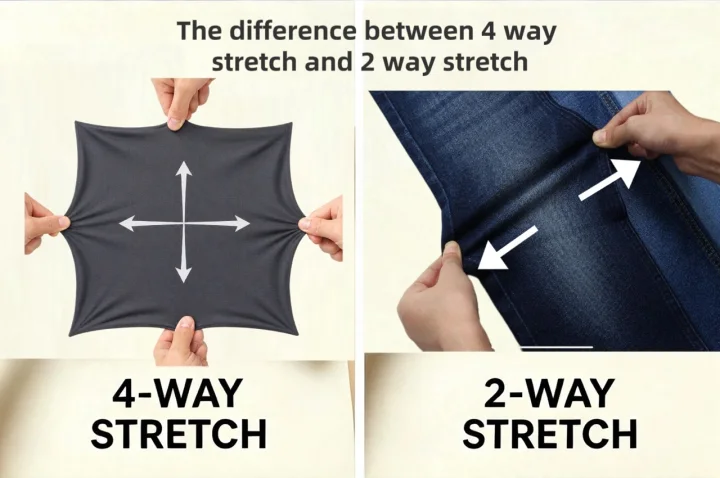
the difference between 2 way stretch fabric and 4 way stretch fabric
What is 2 way stretch fabric
2 way stretch fabric has obvious stretch in mostly one direction, usually the cross direction, the left right width of the fabric.
Put it simply:
- Pull the fabric from left to right, it can stretch out and bounce back once you let go.
- Pull it up and down along the fabric length direction, you will get very little stretch, or almost no stretch at all.
This fabric works well for normal daily activities. It is widely used for everyday clothing.
Common applications: Stretchy casual shirts, stretch denim jeans, bodycon skirt,some elastic casual pants, and other daily garments that only need a small amount of stretch.
What is 4 way stretch fabric
4 way stretch fabric comes with stretch in both cross and length directions. You can pull it left right or up down, and it can spring back after stretching.
- Cross direction (fabric width): stretches side to side
- Length direction (fabric length): stretches up and down
This way, when your body moves in all kinds of directions, the fabric can extend along with your movement for a better fit.
Typical uses: Yoga leggings, tight athletic pants, dancewear, sports bras, swimwear and other close fitting high stretch garments.
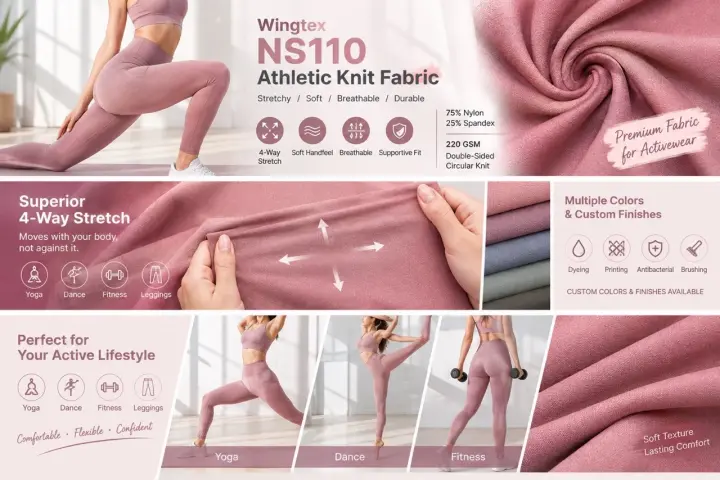
Difference between 2 way stretch and 4 way stretch
| Comparison item | 2 way Stretch | 4 way Stretch |
|---|---|---|
| Cross direction stretch | Yes | Yes |
| Length direction stretch | Mostly very weak | Has stretch |
| Room for movement | Slightly limited | Greater freedom of movement |
| Body hugging effect | Average | Better fit against body |
| Suitable scenarios | Ordinary daily activities | Large range body movements |
| Typical products | denim pants,bodycon skirt,casual clothes | Yoga apparel, activewear, swimwear |
Why 4 way stretch fabric is widely chosen for yoga pants and sportswear
Take yoga pants as an example. When we do squats, lunges or splits, leg muscles expand sideways, and the garment also gets pulled along the length direction.
If the fabric only has cross direction stretch and cannot stretch lengthwise, the fabric will feel tight and restrict your big movements.
4 way stretch fabric can extend along your body’s movement in both directions and move with you. That is why 4 way stretch is often the top pick for yoga leggings, tight sport pants and dance costumes.
If you focus on performance for big movements and multi directional stretch, 4 way stretch does bring more advantages.
Still, not every garment has to use 4 way stretch fabric. For regular shirts and casual pants, 2 way stretch is more than enough.
Some styles actually work better with 2 way stretch fabric, such as stretch jeans and elastic workwear fabric. The cross direction stretch keeps your legs from feeling tight. Since there is almost no lengthwise stretch, the pant length will not easily stretch out and deform, so the silhouette stays neat and good looking.
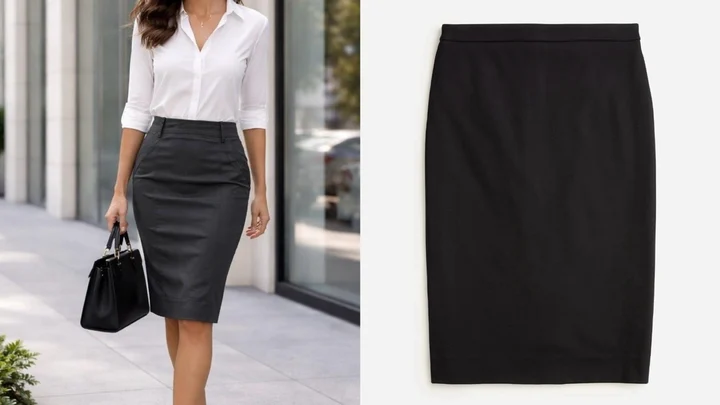
2 way stretch more suitable than 4 way stretch,such as Bodycon skirt
