Cotton vs Bamboo Viscose Fabric Differences: Which Is Better For Underwear&pajama?
To answer this question, let’s start with a popular science fact you may not know:
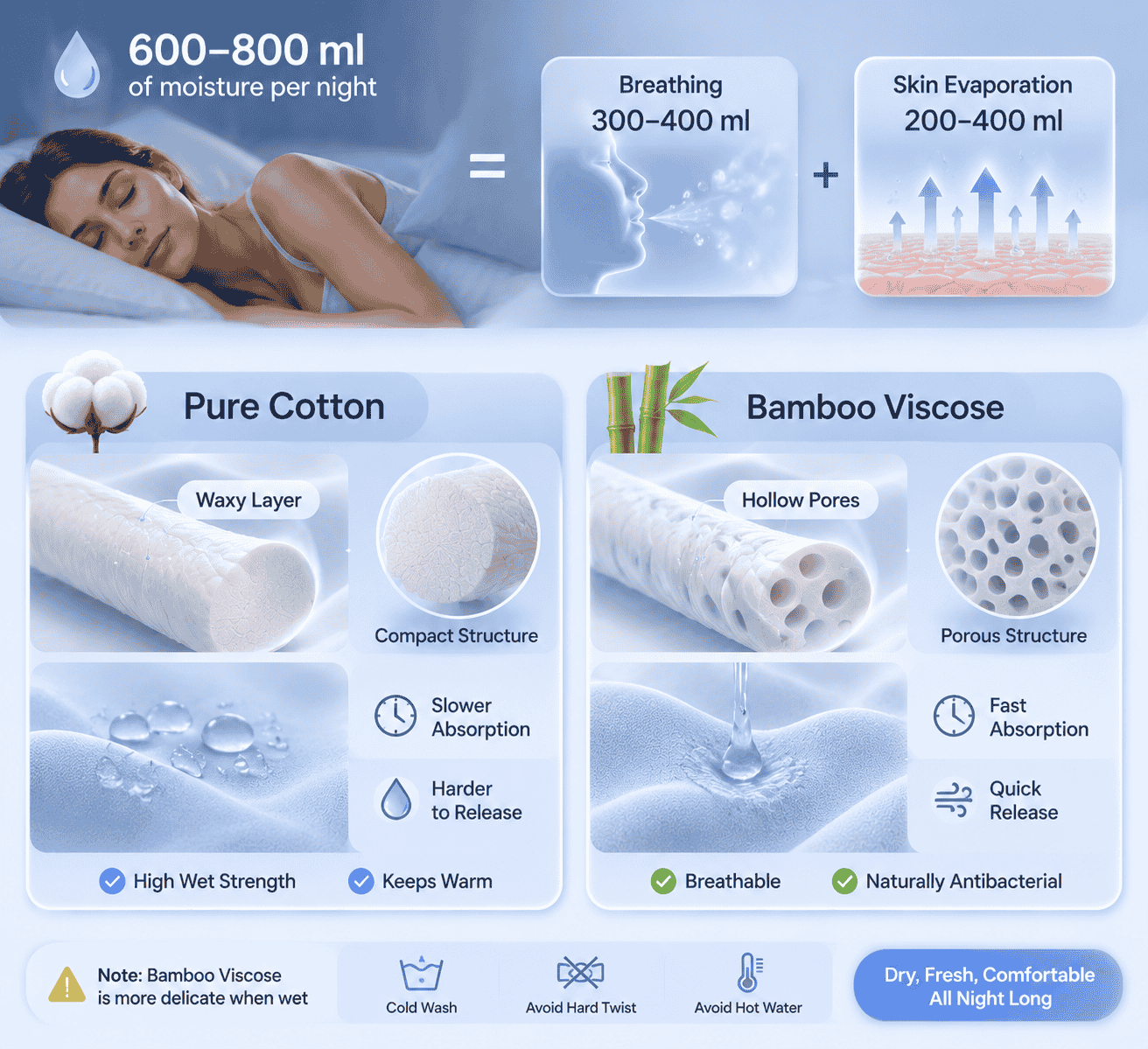
As stated by authoritative medical research institutions,while we sleep, our body does not stop working. Even through breathing and invisible skin evaporation, it continuously releases moisture, around 600 to 800 ml of water vapor.Let’s break down where this moisture comes from.
Part of it comes from breathing: every inhale and exhale carries water vapor from your lungs. This loss is roughly 300 to 400 ml over one night. The other part comes from invisible skin evaporation — even when you are not sweating, your skin keeps releasing moisture, around 200 to 400 ml. Adding these two together, the total lands in the 600–800 milliliter range, so this figure makes sense.
This number is not fixed, of course. If you sleep with air conditioning or heating on, the room stays dry, moisture evaporates faster, and the amount can get close to 800 ml. If it is humid in southern areas or you use a humidifier, evaporation drops to 400–500 ml. If you have a larger build, fast metabolism, or drink lots of water before bed, your moisture output will also go up.
Once you understand this, you can see the core difference between cotton and bamboo viscose fabric: moisture absorption and moisture release. Whether this moisture can disperse quickly depends entirely on the internal structure of the fiber. This is the key dividing line between cotton and bamboo viscose.
First, let’s talk about pure cotton fabric.
Cotton fiber has a natural waxy protective layer on its surface. This wax layer blocks some water, so cotton cannot soak up water instantly, and its water absorption speed is noticeably slow. Cotton fiber has a compact internal structure and high crystallinity. Water vapor can only seep slowly into the fiber; it takes in water but does not easily release moisture outwards.
Some people may not understand what crystallinity means. Put simply: crystallinity is the share of molecules inside a single fiber that line up neatly and sit tightly together, out of all its molecules. Cotton’s high crystallinity means most molecules inside cotton fiber hold firmly to one another, leaving very small gaps between molecules. Water struggles to get in between these molecules and can only seep in little by little. Since these molecules stick together tightly, they do not pull apart easily even when soaked, so cotton stays sturdy after getting wet.
For this reason, when you wear pure cotton underwear, the moisture your body releases overnight easily gets trapped by the cotton fabric, locked between the fabric and your skin. Sometimes the fabric feels damp by the middle of the night.
Pure cotton also has clear strengths. Cotton fiber becomes sturdier when wet. It has high wet strength. You can machine wash it freely, twist it hard, and dry it repeatedly. Its fibers do not break easily. It will not thin out or turn loose after long-term use, and keeps its shape for years. Besides, cotton holds still air well, so it delivers better warmth retention. It locks in body heat steadily in autumn and winter, and its warmth performance is hard to match.
Quick summary of pure cotton: slow moisture absorption, weak moisture release, easy to hold moisture; high wet strength, withstands repeated washing, great warmth retention, simple to care for.
Next, let’s talk about bamboo viscose.
Bamboo viscose is a man-made regenerated cellulose fiber. Bamboo slices are cooked to remove impurities, and cellulose is extracted to make bamboo pulp. The pulp is dissolved, pushed through tiny holes to set into filaments, then washed and dried to make bamboo viscose.
The fiber is filled with hollow pores and fine capillary channels. It has no wax waterproof layer, and carries lots of hydrophilic groups. Its moisture absorption speed is several times faster than pure cotton. The steady water vapor released overnight gets absorbed by bamboo fiber right away, then evaporates fast through the fiber pores. It absorbs moisture and releases moisture at the same time, so moisture will not get trapped inside the fabric. Even if you sweat easily or feel hot at night, your skin stays dry, with no sticky feeling next to your skin. At the same time, phenolic substances naturally found in bamboo bring natural antibacterial properties. It does not easily grow mites and bacteria, so it works better for direct skin contact.
Bamboo viscose fabric also has obvious drawbacks, which also come from its fiber structure. When bamboo viscose fabric soaks in water, it swells. Hydrogen bonds between molecular chains get weakened by water. Its wet pulling resistance drops a lot, only around 60% of its dry state. If you wash it in hot water, twist it hard, or wash it roughly in a machine, the fibers will easily fuzz, loosen and thin out. To extend its service life, you can only wash it gently in cold water and avoid strong pulling.
Quick summary of bamboo viscose: fast moisture absorption and fast moisture transmission, excellent moisture release; low wet strength, cannot stand rough washing, needs gentle care, cool touch, fits warm environments better.
Final selection guide
1、If you use it mainly in autumn and winter, value durability, often wash large batches in the washing machine, and do not want to take extra care of it, pick pure cotton first. Even though it holds moisture easily, it lasts long, and costs less over time.
2、If you tend to feel hot and sweat while sleeping, want dry comfort, use it mostly in spring and summer, and are okay with gentle washing, pick bamboo viscose.
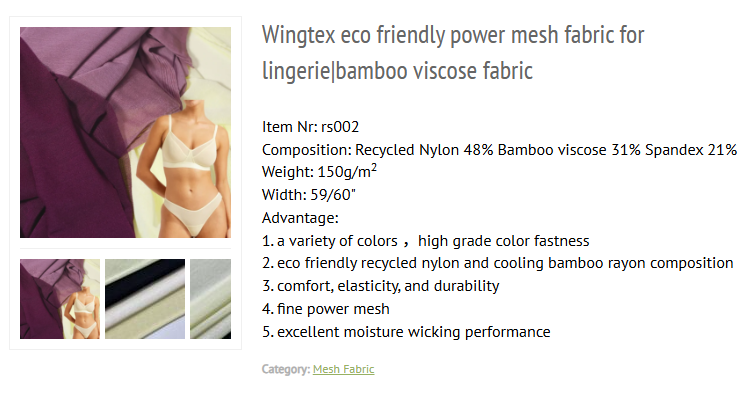
3、Wingtex RS002 bamboo viscose regenerated nylon blended power mesh fabric
48% regenerated nylon + 31% bamboo viscose + 21% spandex, scientifically tuned golden component ratio. It fixes the problem that bamboo viscose fabric cannot stand washing, while pure synthetic fiber lacks good moisture absorption, moisture release and hand feel. It draws on the strengths of both materials and makes up for each other’s weaknesses, fully meeting all requirements for close-fitting garments.
Regenerated nylon also gives brands an eco-friendly selling point, lifts product premium, eco-friendly and natural while keeping reliable performance. The warp knitting structure mixed with 21% spandex gives the fabric good elasticity, it achieves 4 way stretch. On top of that, this fabric uses fine mesh structure, pushing its air permeability to a higher level. This regenerated eco nylon plus bamboo viscose fine mesh fabric is very hard to produce. Identical fabric is rarely seen on the market. It works perfectly for clothing brands that want high-performance differentiated products.
Wingtex RS002 bamboo viscose regenerated nylon blended power mesh fabric
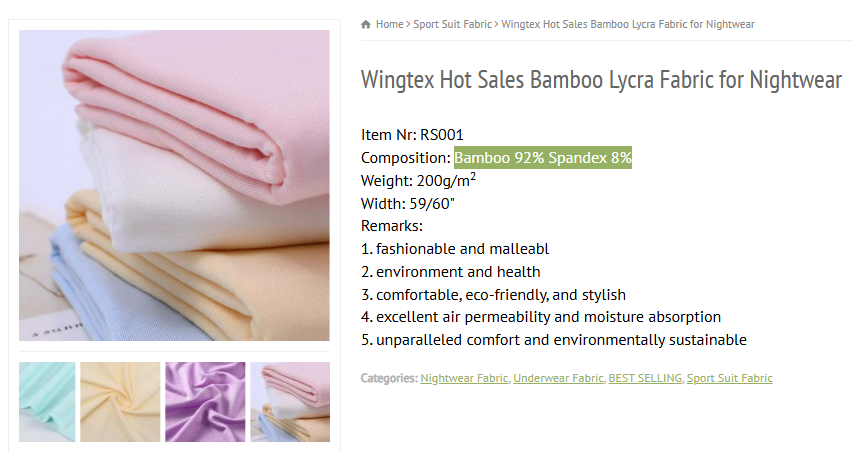
4、Wingtex RS001 92% Bamboo viscose +Spandex 8% for pajama fabric
Wingtex Bamboo Lycra fabric consists of 92% bamboo viscose and 8% spandex. Bamboo viscose has many tiny pores inside the fiber, so the fabric absorbs moisture, breathes well and feels soft against skin. It can quickly move moisture away from your skin. Bamboo grows fast, so this fabric is renewable and eco-friendly. The added spandex gives stretch and recovery. It dyes well and supports custom colors and prints. It works well for close-fitting products such as nightwear and underwear
Wingtex RS001 92% Bamboo viscose +Spandex 8% for pajama fabric
We welcome your inquiries. Wingtex provides free samples of RS002 bamboo viscose mesh fabric, and 24-hour online customer service to answer all other questions you have about this fabric.