
What’s the POY / FDY / DTY / ATY in the Textile Industry
POY, FDY, DTY and ATY are not four different raw materials for yarn. They refer to yarns made by four different production processes. For example, all these yarns can use polyester as raw material. Only the production stage and processing method are different, which makes big differences in the final yarn’s hand feel, look and usage. Let’s break them down one by one.
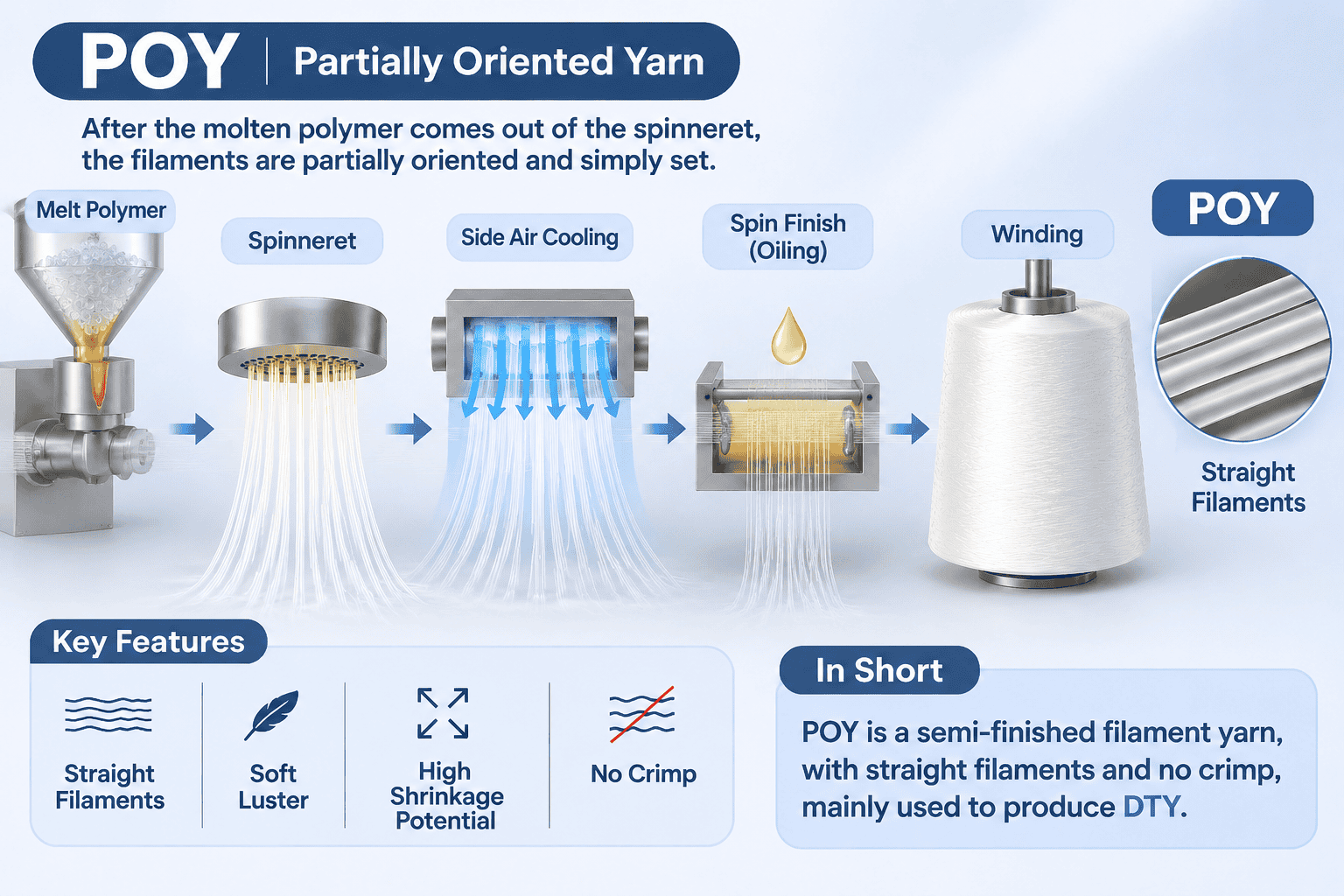
What’s the POY?
POY — Full name: Pre-Oriented Yarn
Simple explanation: After the melt comes out of the spinneret, it only gets basic stretching and simple setting. It is not fully stretched and still has much room for further stretching. It is a semi-finished filament and is generally not used directly for weaving.
Features of POY:
(1) The yarn stays straight, but its inner structure is not stable
(2) Low strength; it will shrink a lot after being stretched
(3) It has no crimp and soft shine
(4) Hardly used directly to make fabrics
(5) Mostly used for further processing into DTY
One-sentence summary: POY is a half-finished filament, mostly used to produce DTY.
What’s the POY
What’s the FDY?(See wingtex FDY underwear fabric)
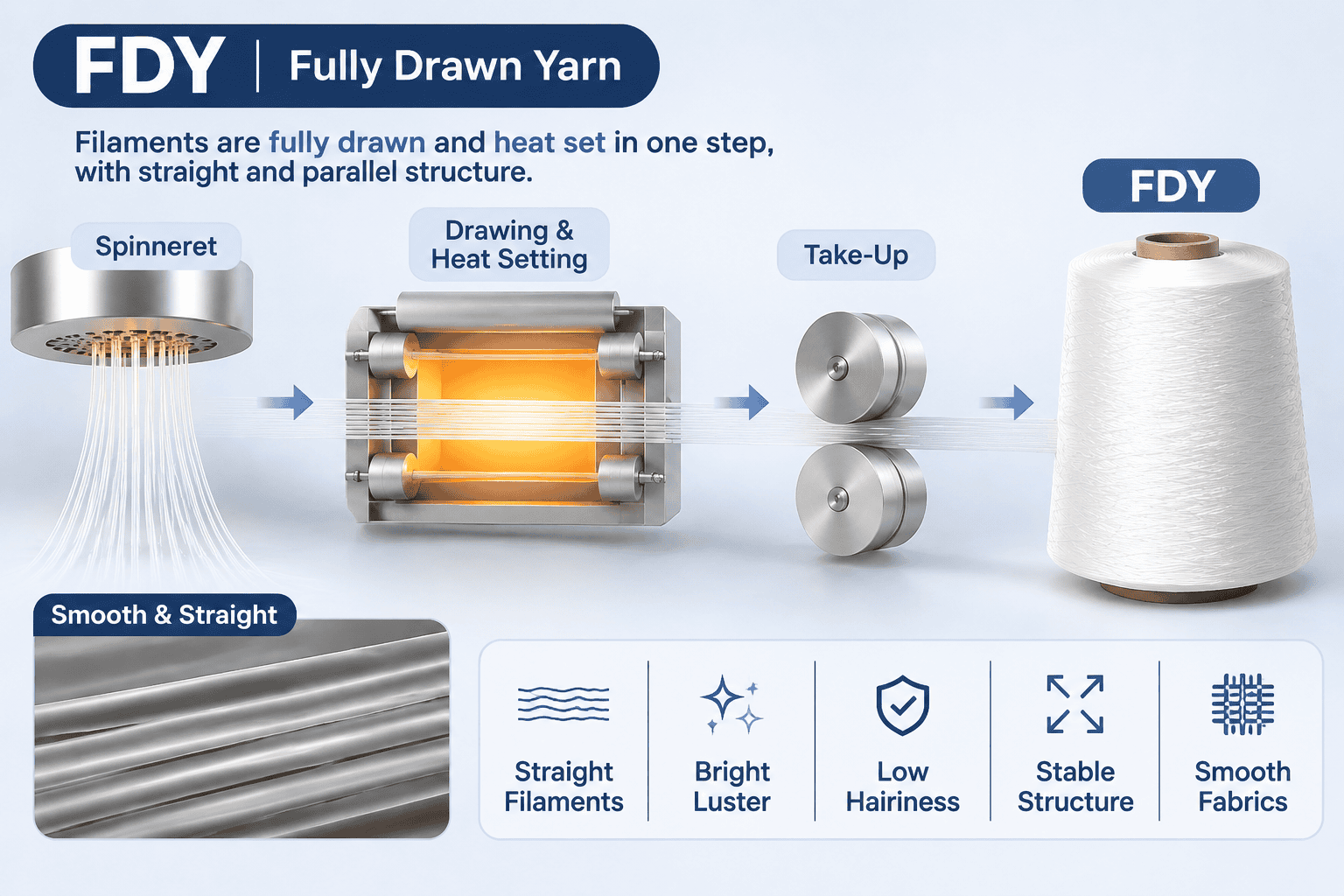
FDY — Full name: Fully Drawn Yarn
Simple explanation: During spinning and forming, this bundle of filaments is fully stretched in one step, with high-temperature setting done at the same time. Inside the finished yarn, single filaments stay parallel to each other, and the yarn itself has no crimp.
Features of FDY:
(1) Straight and even yarn with smooth surface
(2) Few loose fibers, clean look
(3) Quite obvious shine
(4) Stable yarn structure, low shrinkage
(5) Mostly used for fabrics that need flat and smooth surface
One-sentence summary: FDY is set filament with parallel straight threads and smooth surface.
What’s the FDY?
What’s the DTY?(See wingtex DTY leggings fabric)
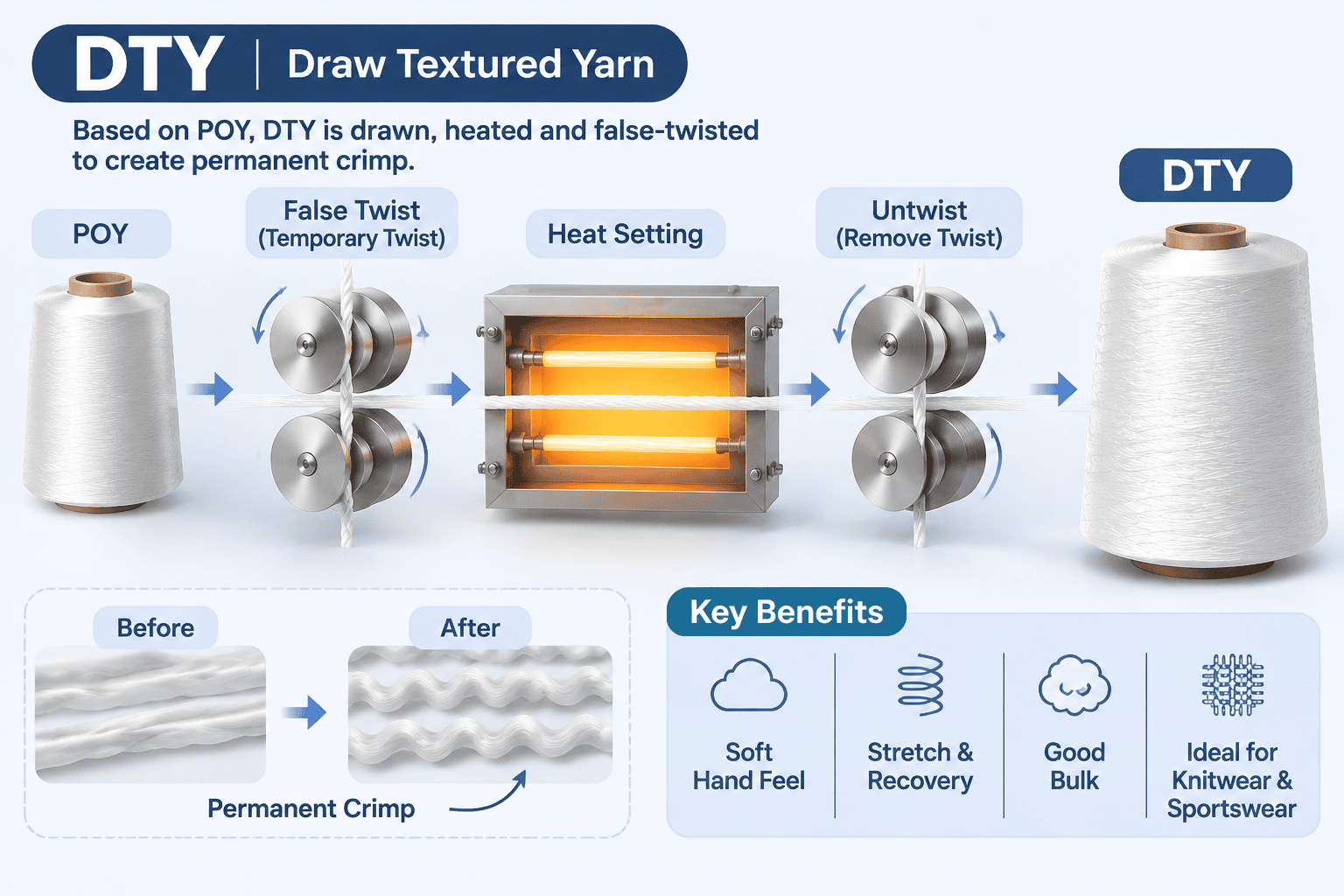
DTY — Full name: Draw Textured Yarn
Simple explanation: POY semi-finished filament is usually used as base material. During production, stretching, heating and false-twist texturing happen at the same time. This creates fixed continuous crimp on filaments. This crimp can bounce back; after you pull and release it, it returns to its original shape.
Features of DTY:
(1) Built-in continuous crimp, good bulkiness
(2) Soft hand feel
(3) Stretch and rebound ability
(4) Fabric woven from it is not shiny and smooth like FDY fabric
(5) Widely used for knitted fabrics, sport fabrics and stretch fabrics
One-sentence summary: DTY is filament with crimp and elasticity, made from POY through false-twist heat texturing.
What’s the DTY?
False twist is a yarn processing step: first twist the yarn into a spiral shape temporarily, heat to set the shape, then untwist the spiral structure. Straight filaments go into the false twist disc and are temporarily twisted into a spiral, with many single filaments twisted together. While keeping this twisted state, the filaments get high-temperature heat setting, so every single filament keeps its bent shape. Then filaments pass through the false twist disc. Reverse rotation immediately removes all the temporary twist made before. After leaving the processing area, you cannot see rope-like twist marks on the yarn surface.
Although the twisting force is released, heat setting has locked the bent shape of single filaments. The twist disappears, but crimp stays forever inside each thin filament. This is yarn processed by false twist: no visible twist lines, yet it feels fluffy and stretchy.
After straight filaments go through false twist setting, countless single filaments have continuous wave crimp. The whole yarn becomes fluffy, stretchy and rebounds well, and the fabric can cover better.
This process is similar to perming hair in a barbershop: first wrap hair around rods, use high heat to create curved shape. When you take away the rods, the curve remains. The only difference is false twist does not use rods to “keep shape”; it makes curved shapes by twisting filaments together into spirals.
What’s the ATY?(See wingtex ATY supplex fabric)
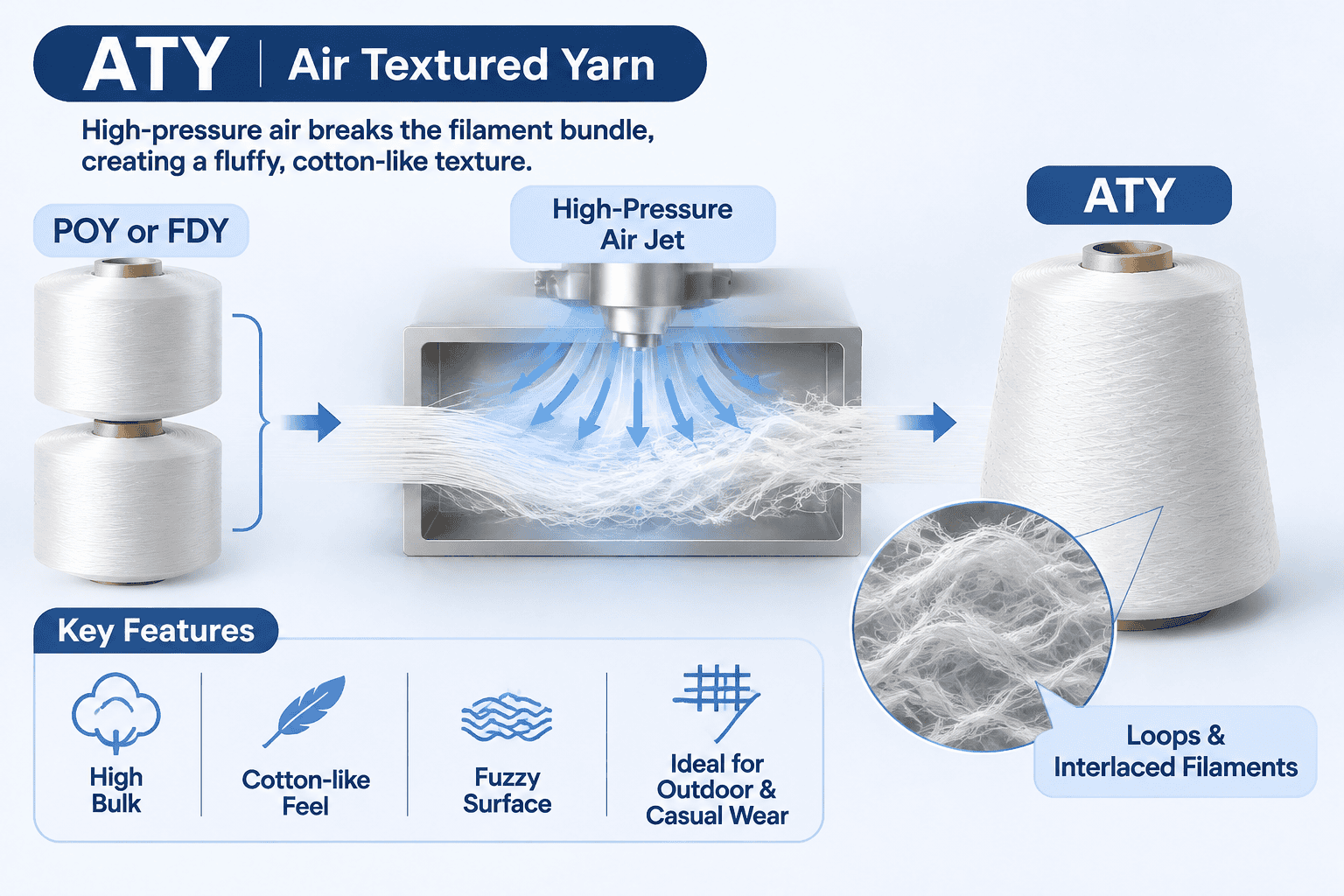
ATY — Full name: Air Textured Yarn
Simple explanation: Raw material can be POY or FDY filament bundles. It does not use heating and false twist to make crimp. Instead, high-pressure compressed air hits the filament bundle, disturbs the originally parallel single filaments, makes single filaments cross each other and creates many small loops on the yarn surface.
Features of ATY:
(1) Many small loops and loose fibers on the yarn surface
(2) High bulkiness overall
(3) Look and hand feel close to cotton yarn, often used for cotton-like and wool-like effect
(4) Hairy surface, without the slippery feel of shiny filament yarn
(5) Mostly used for outdoor fabrics and casual sport fabrics
One-sentence summary: ATY uses high-pressure air flow to break filament structure and get texture similar to short-fiber cotton yarn
What’s the ATY?
